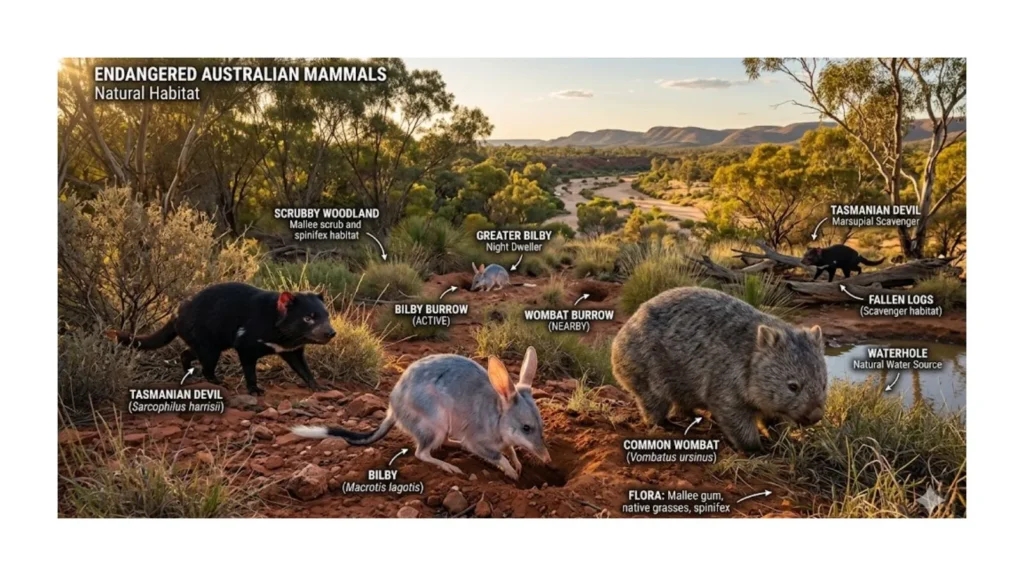
Australia shelters some of the most extraordinary creatures on Earth. Yet, many of these species now teeter on the brink of extinction. From elusive marsupials to tiny nocturnal hunters, endangered Australian mammals face mounting threats.
|See also: wild animals in cambodia
Understanding their biology, behavior, and conservation needs is essential to protect this irreplaceable biodiversity.
Scientific Classification
Endangered Australian mammals belong primarily to class Mammalia, including marsupials like kangaroos and monotremes like echidnas, classified under diverse orders such as Diprotodontia and Dasyuromorphia.
Physical Characteristics
These mammals vary widely in size, fur texture, and features. Some have pouches for offspring, while others possess sharp claws, dense fur, or elongated snouts for specialized feeding.
Habitat and Distribution
They inhabit forests, deserts, grasslands, and coastal areas across Australia. However, habitat fragmentation has restricted many species to isolated and shrinking regions.
Diet and Hunting Behavior
Most endangered Australian mammals are omnivores or insectivores. They forage at night, using keen senses to locate insects, roots, or small prey.
Reproduction and Lifespan
Many reproduce slowly, with few offspring each year. Marsupials nurture young in pouches, while lifespans vary from short-lived rodents to longer-living larger mammals.
Behavior and Adaptations
These animals display nocturnal habits, burrowing skills, and camouflage. Adaptations help them survive harsh climates, but rapid environmental changes challenge these traits.
Threats and Conservation Status
Major threats include habitat loss, invasive predators, bushfires, and climate change. Many species are listed as endangered or critically endangered under conservation frameworks.
Interesting Facts
Some species can survive without water for long periods. Others use electroreception or store fat in tails, showcasing remarkable evolutionary adaptations.
Key Examples of Endangered Australian Mammals
1. Bilby (Macrotis lagotis)
Once widespread, bilbies now occupy limited desert regions. Their long ears and burrowing habits make them unique ecosystem engineers.
Key Features:
- Large ears regulate temperature
- Strong claws for digging
- Nocturnal lifestyle
2. Tasmanian Devil (Sarcophilus harrisii)
Famous for its fierce growl, this carnivorous marsupial suffers from a contagious facial tumor disease.
Notable Traits:
- Powerful jaws
- Scavenger diet
- Vital role in cleaning ecosystems
3. Northern Hairy-nosed Wombat
One of the rarest mammals globally, with fewer than 300 individuals remaining.
Distinct Traits:
- Thick fur
- Burrow-dwelling behavior
- Herbivorous diet
4. Greater Glider
This tree-dwelling marsupial glides between branches but struggles due to deforestation.
Diagram: Threat Cycle Affecting Endangered Mammals
Habitat Loss → Reduced Population → Genetic Weakness
        ↓                          ↑
 Climate Change ← Increased Vulnerability
Table: Comparison of Selected Endangered Australian Mammals
| Species | Habitat | Diet | Main Threat |
|---|---|---|---|
| Bilby | Desert | Omnivore | Predators, habitat loss |
| Tasmanian Devil | Forest | Carnivore | Disease |
| Hairy-nosed Wombat | Grassland | Herbivore | Habitat destruction |
| Greater Glider | Forest canopy | Herbivore | Deforestation |
Benefits of Protecting Endangered Australian Mammals
Preserving these species delivers ecological and societal advantages.
Ecological Benefits
- Maintain soil health through burrowing
- Control insect populations
- Support food chain balance
Environmental Uses
- Indicators of ecosystem health
- Aid in biodiversity conservation
- Enhance climate resilience
Safety and Risks in Conservation Efforts
While conservation is essential, it involves challenges.
Potential Risks
- Relocation stress in animals
- Human-wildlife conflict
- Limited funding resources
Practical Safety Tips
- Avoid disturbing wildlife habitats
- Support ethical tourism
- Follow conservation guidelines
Practical Tips to Help Conservation
Small actions can create meaningful change.
- Support wildlife organizations
- Reduce land pollution
- Promote sustainable living
- Spread awareness online
- Participate in conservation programs
FAQs
1. Why are Australian mammals highly endangered?
Australia’s isolation led to unique species, but they lack defenses against introduced predators and environmental changes.
2. Which is the most endangered mammal in Australia?
The Northern Hairy-nosed Wombat is among the rarest, with critically low population numbers.
3. How can humans help protect these species?
People can support conservation groups, reduce environmental impact, and advocate for wildlife protection policies.
4. Are all Australian mammals marsupials?
No, while many are marsupials, Australia also has monotremes like the platypus.
5. What role do these mammals play in ecosystems?
They maintain soil health, control pests, and support biodiversity.
Summary
Endangered Australian mammals represent a fragile yet vital component of global biodiversity. Their unique adaptations and ecological roles highlight the importance of preserving them. However, growing threats demand urgent conservation efforts.
Protecting these species ensures environmental stability and safeguards Australia’s natural heritage.