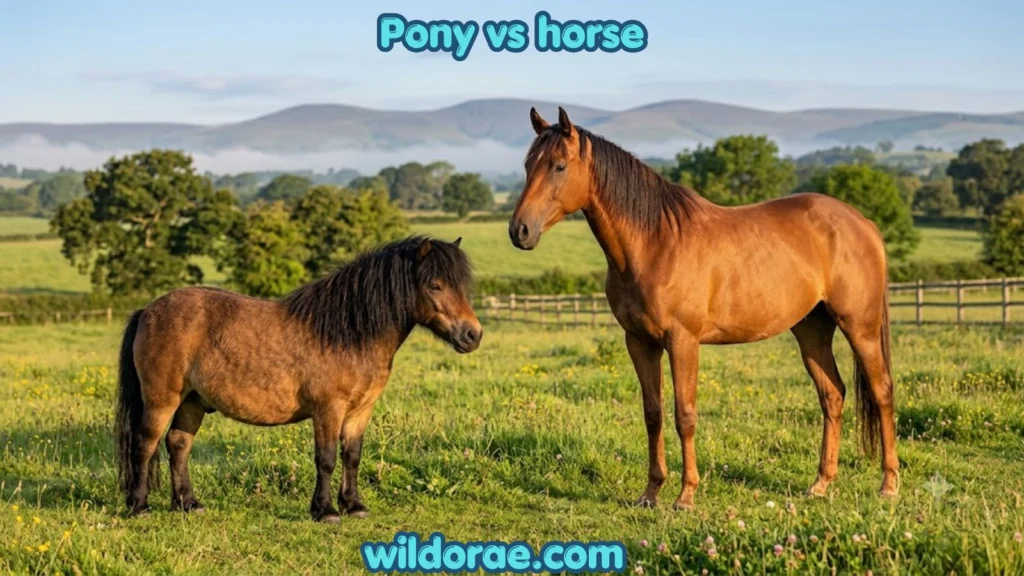
Have you ever looked at a small horse and wondered whether it was actually a pony?
Many people think ponies are simply baby horses, but that’s one of the biggest myths about these amazing animals. While ponies and horses belong to the same species, they have several physical and behavioral differences that set them apart.
Understanding the difference between a pony vs horse is useful for wildlife lovers, horse owners, students, and anyone interested in animals. From their height and body shape to their temperament and daily care, each has unique qualities that make them special.
You’ll learn how ponies and horses differ, where they live, how they are used, and which one may be a better choice depending on your needs. By the end, you’ll be able to identify them with confidence and appreciate what makes each one unique.
Learn More About: Wildlife Photography Internship
Pony vs Horse – Quick Answer
The main difference between a pony vs horse is height. A pony usually measures 14.2 hands (58 inches or 147 cm) or less at the withers (the highest point of the shoulders). Any equine taller than this is generally considered a horse.
However, size isn’t the only difference. Ponies typically have:
- Shorter, stronger legs
- Thicker necks
- Wider bodies
- Dense manes and tails
- Smaller ears
- A sturdy build
Horses, on the other hand, are generally:
- Taller and longer-legged
- Leaner and more athletic
- Faster over long distances
- Bred for riding, racing, farming, and sports
Although they share many similarities, their appearance, personality, and abilities make them easy to tell apart once you know what to look for.
What Is a Pony?
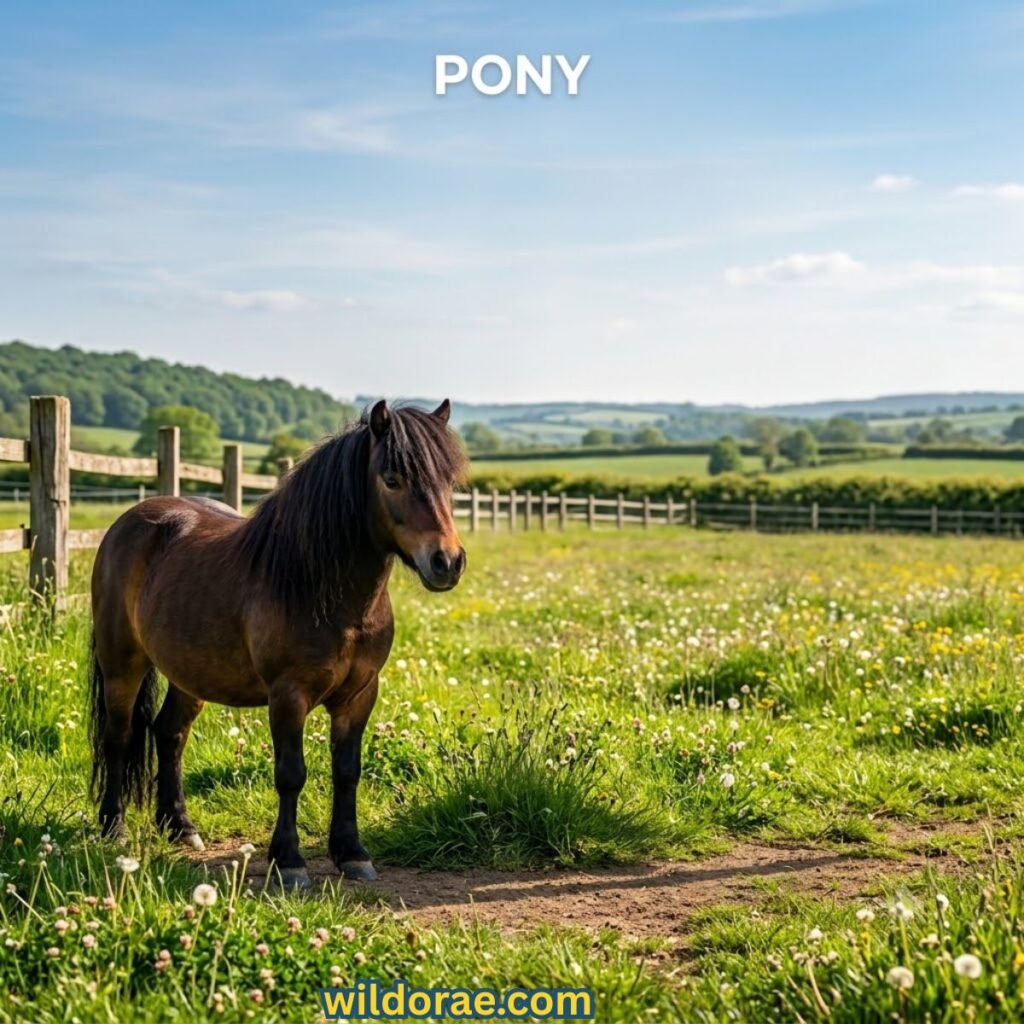
A pony is a fully grown equine that stays naturally small throughout its life. It is not a young horse. Ponies belong to the same species as horses (Equus ferus caballus), but selective breeding over hundreds of years has produced compact animals with remarkable strength.
Many pony breeds evolved in harsh environments where food was limited. As a result, they developed sturdy bodies, thick coats, and excellent endurance.
Common Characteristics of Ponies
- Height under 14.2 hands
- Compact and muscular body
- Thick mane and tail
- Short, strong legs
- Broad chest
- Strong hooves
- Excellent endurance
- Intelligent and curious personality
Despite their small size, ponies are incredibly powerful. Some can pull loads much heavier than their own body weight.
What Is a Horse?
A horse is an adult equine that stands taller than 14.2 hands. Horses have been companions to humans for thousands of years, serving in transportation, agriculture, sports, warfare, and recreation.
Modern horses come in hundreds of breeds, each developed for specific purposes such as racing, dressage, jumping, ranch work, or trail riding.
Common Characteristics of Horses
- Height above 14.2 hands
- Long legs
- Lean, athletic body
- Longer neck
- Greater speed
- Longer stride
- Excellent stamina
- Wide variety of colors and coat patterns
Horses are known for their grace, intelligence, and ability to form strong bonds with humans.
Pony vs Horse: Key Differences
Although ponies and horses belong to the same species, several features help distinguish them.
| Feature | Pony | Horse |
|---|---|---|
| Height | Up to 14.2 hands | Above 14.2 hands |
| Build | Stocky and muscular | Taller and leaner |
| Legs | Short and sturdy | Long and elegant |
| Mane | Thick and coarse | Usually finer |
| Tail | Fuller | Longer and smoother |
| Strength | Very strong for size | Strong overall |
| Speed | Moderate | Faster |
| Temperament | Intelligent, stubborn, curious | Calm, trainable, athletic |
Pony vs. Draft Horse: What’s the Difference?
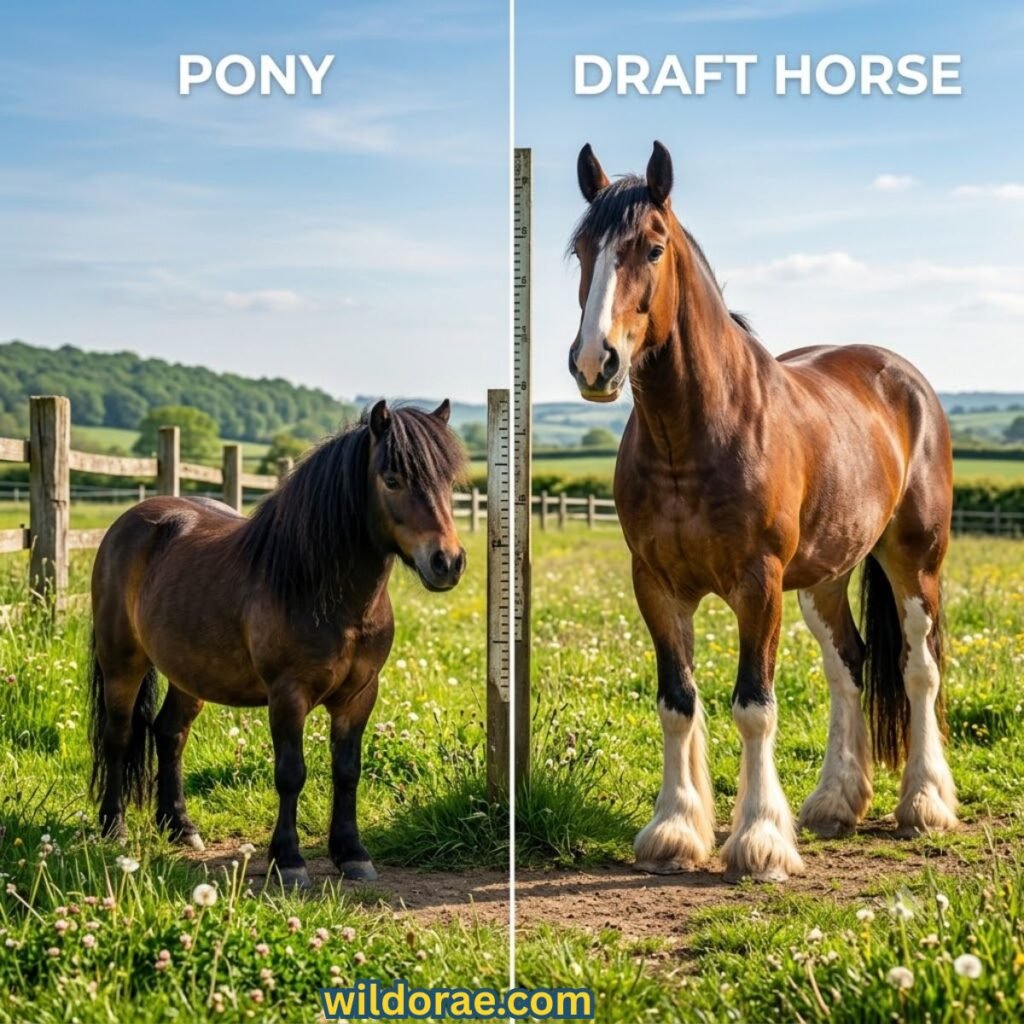
A pony and a draft horse differ mainly in size, strength, and purpose. Ponies are small, sturdy, and often used for riding, driving, or children’s activities. Draft horses are much larger, more powerful, and bred for heavy work such as farming, logging, and pulling wagons. Both are intelligent, gentle, and valued for different roles.
Size Comparison
Height is the easiest way to tell a pony from a horse.
Pony Height
Most ponies stand between:
- 9–14.2 hands
- Approximately 36–58 inches
Popular pony breeds:
- Shetland Pony
- Welsh Pony
- Connemara Pony
- Exmoor Pony
Horse Height
Most horses stand between:
- 15–17 hands
- Approximately 60–68 inches
Some draft horses grow even taller than 18 hands.
Body Shape and Appearance
One of the easiest ways to recognize a pony is by its sturdy body.
Ponies have:
- Thick necks
- Broad shoulders
- Round barrels
- Dense bones
- Short backs
These features help them survive in cold climates and rough landscapes.
Horses appear more elegant because they have:
- Longer necks
- Longer legs
- Narrower bodies
- Refined heads
- Athletic muscles
This body structure allows horses to excel in speed and performance sports.
Mane, Tail, and Coat
Ponies often have thick, shaggy manes and tails that protect them from harsh weather. During winter, many pony breeds grow dense coats that help them stay warm.
Horses also grow winter coats, but many breeds have smoother, finer hair. Their manes and tails are often less coarse than those of ponies.
Because of these adaptations, ponies require less shelter in cold environments than many horse breeds.
Temperament and Personality
Personality is another important difference in the pony vs horse comparison.
Ponies are famous for being:
- Smart
- Curious
- Independent
- Playful
- Determined
Some people even describe ponies as stubborn. In reality, they are highly intelligent and quickly learn both good and bad habits.
Horses tend to be:
- Calm
- Responsive
- Gentle
- Athletic
- Easier to train for advanced riding disciplines
Both animals are social and enjoy living in groups, making companionship important for their well-being.
Strength and Speed
When comparing pony vs horse, many people assume that horses are stronger simply because they are larger. While horses can carry heavier riders and pull larger loads, ponies are incredibly powerful for their size.
A pony has a compact body, dense bones, and strong muscles. These features allow it to pull or carry loads that seem surprising for such a small animal. This natural strength helped ponies work on farms, in mines, and across rough mountain trails for centuries.
Horses, however, have the advantage in speed and endurance. Their longer legs create a greater stride length, making them ideal for racing, jumping, and long-distance riding.
Strength Comparison
- Pony: Extremely strong relative to its size
- Horse: Greater overall strength and carrying capacity
Speed Comparison
- Pony: Moderate speed
- Horse: Faster with better endurance over long distances
Lifespan
Another interesting difference between a pony vs horse is lifespan.
Ponies generally live longer than horses because of their hardy genetics and slower growth. With proper nutrition, exercise, and veterinary care, many ponies remain healthy well into their 30s.
Average Lifespan
| Animal | Average Lifespan |
|---|---|
| Pony | 25–35 years |
| Horse | 25–30 years |
Some individuals even live beyond these averages with excellent care.
Popular Pony Breeds
Many pony breeds are known for their intelligence, strength, and friendly nature.
Shetland Pony
Originally from Scotland’s Shetland Islands, this breed is famous for its small size and incredible strength.
Characteristics
- Height: 28–42 inches
- Thick coat
- Gentle but spirited personality
- Excellent for children’s riding and driving
Welsh Pony
The Welsh Pony is athletic, elegant, and highly versatile.
It is commonly used for:
- Riding
- Jumping
- Driving competitions
Connemara Pony
Native to Ireland, the Connemara Pony is one of the world’s finest riding ponies.
It is known for:
- Calm temperament
- Excellent jumping ability
- Intelligence
- Endurance
Exmoor Pony
One of Britain’s oldest native breeds, the Exmoor Pony still retains many wild characteristics.
Popular Horse Breeds
Horses come in hundreds of breeds developed for different purposes.
Arabian Horse
Known for:
- Intelligence
- Beauty
- Exceptional endurance
Arabian horses are among the oldest horse breeds in the world.
Thoroughbred
This breed dominates horse racing thanks to its incredible speed and athletic ability.
Quarter Horse
The American Quarter Horse is popular because of its:
- Calm temperament
- Quick acceleration
- Ranch work abilities
- Versatility
Clydesdale
Clydesdales are massive draft horses recognized by their feathered legs and remarkable pulling strength.
Uses of Ponies vs Horses
Although ponies and horses share many similarities, people use them for different activities.
Common Uses of Ponies
Ponies are often chosen for:
- Children’s riding lessons
- Trail riding
- Driving carts
- Farm work
- Petting zoos
- Conservation grazing
- Companion animals
Because they are smaller, many children feel more comfortable learning to ride a pony.
Common Uses of Horses
Horses are widely used for:
- Racing
- Show jumping
- Dressage
- Polo
- Ranch work
- Police patrols
- Search and rescue
- Long-distance riding
- Farming
Their athletic ability makes them suitable for demanding sports and professional work.
Habitat and Diet
Both ponies and horses thrive in grasslands, meadows, open woodlands, and farms.
In the wild, they naturally graze for many hours each day.
Their diet mainly includes:
- Grass
- Hay
- Fresh water
- Mineral supplements
- Grains (when needed)
Ponies usually require less food than horses because they have slower metabolisms. In fact, overfeeding can easily cause obesity in many pony breeds.
Pony vs Horse Comparison Table
| Feature | Pony | Horse |
|---|---|---|
| Height | Up to 14.2 hands | Over 14.2 hands |
| Weight | Lighter | Heavier |
| Body | Stocky | Lean |
| Legs | Short | Long |
| Mane | Thick | Usually finer |
| Speed | Moderate | Fast |
| Strength | Very strong for size | Greater total strength |
| Lifespan | 25–35 years | 25–30 years |
| Best For | Children, farms, driving | Sports, racing, riding |
| Maintenance | Easier in many cases | Usually more demanding |
Which One Should You Choose?
Choosing between a pony and a horse depends on your experience, goals, and lifestyle.
A pony may be the better option if you:
- Have young children
- Need a hardy animal
- Prefer lower feed costs
- Enjoy recreational riding
- Want an intelligent companion
A horse is often the right choice if you:
- Compete in equestrian sports
- Need greater speed
- Want longer trail rides
- Require a larger riding animal
- Plan to participate in racing or jumping
Neither is better than the other. Each has strengths that make it special.
Common Myths About Ponies and Horses
Myth 1: Ponies are baby horses.
Fact: Ponies are fully grown adults that naturally stay small.
Myth 2: Horses are always friendlier.
Fact: Personality depends more on training and handling than size.
Myth 3: Ponies are weak.
Fact: Ponies are among the strongest animals relative to their body size.
Myth 4: All small horses are ponies.
Fact: Some horse breeds remain small but are still classified as horses because of their body proportions and genetics.
Frequently Asked Questions
Is a pony just a young horse?
No. A pony is a mature equine breed that naturally remains smaller than a horse.
What height separates a pony from a horse?
Generally, an equine measuring 14.2 hands (58 inches or 147 cm) or less is classified as a pony.
Are ponies easier to care for?
Ponies often require less food and are hardy animals. However, they still need proper nutrition, shelter, grooming, and regular veterinary care.
Which is stronger, a pony or a horse?
Horses have greater overall strength, but ponies are exceptionally strong for their size.
Can adults ride ponies?
Some larger pony breeds, such as the Connemara Pony, can comfortably carry many adult riders.
Are ponies faster than horses?
No. Horses generally run faster because of their longer legs and greater stride length.
Conclusion
Understanding the differences between a pony vs horse helps you appreciate these remarkable members of the equine family. While they belong to the same species, ponies stand out with their compact bodies, thick coats, intelligence, and surprising strength. Horses, on the other hand, are taller, faster, and better suited for demanding sports, long-distance riding, and heavy work.
Whether you admire a sturdy Shetland Pony or a graceful Arabian Horse, both animals have played an important role in human history and continue to inspire wildlife enthusiasts around the world. By recognizing their unique traits, you can better understand their care, behavior, and value in both domestic and natural environments.