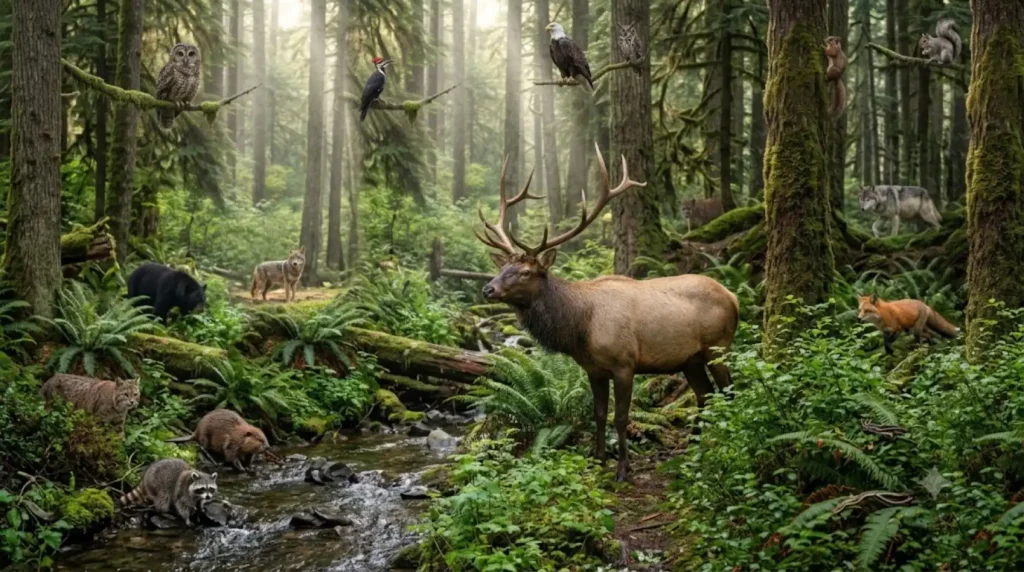
Imagine walking beneath towering Douglas firs while a black bear quietly moves through the brush, elk graze beyond the trees, and an owl watches from an ancient branch. Oregon’s forests are alive with hidden activity.
The animals in Oregon forest habitats represent a remarkable mix of mammals, birds, amphibians, reptiles, and countless smaller creatures. From the damp Coast Range to the rugged Cascades and Blue Mountains, forests provide food, shelter, nesting sites, and travel corridors.
Oregon’s forests also contain different habitat layers. Dense canopies shelter birds, fallen logs protect amphibians, while forest openings provide forage for deer and elk. Consequently, each layer supports a different part of the ecosystem.
The Oregon Department of Forestry notes that forests provide essential wildlife habitat, clean water, recreation, and other environmental benefits.
Read: Wildlife Internships with Housing
Read: List of Spring Animals: Fascinating Creatures That Thrive in Spring
Read: Dreaming Wild Animals
Animals in Oregon Forest: Quick Overview
The animals in Oregon forest ecosystems include large predators, herbivores, omnivores, birds, and smaller forest specialists.
| Animal | Main Habitat | Food | Notable Trait |
|---|---|---|---|
| Black bear | Forests, streams, mountains | Plants, berries, insects, small animals | Excellent climber |
| Roosevelt elk | Western Oregon forests | Grasses, shrubs, vegetation | Large-bodied elk |
| Cougar | Rugged forests and mountains | Deer, elk, mammals | Solitary predator |
| Black-tailed deer | Forest edges and woodland | Leaves, shrubs, grasses | Adaptable browser |
| Northern spotted owl | Older forests | Small mammals | Forest-dependent owl |
| Raccoon | Woodlands near water | Fruit, insects, small animals | Highly adaptable |
| Beaver | Streams, ponds, wetlands | Bark and aquatic plants | Ecosystem engineer |
Oregon wildlife officials identify black bears, Roosevelt elk, cougars, deer, owls, beavers, raccoons, and many other species across the state’s forest landscapes.
List of Wild Animals in Oregon Forests
Some common wild animals in Oregon forests include:
- Black bears
- Cougars
- Roosevelt elk
- Black-tailed deer
- Raccoons
- Beavers
- Bobcats
- Gray wolves
- Coyotes
- Red foxes
- Douglas squirrels
- Northern spotted owls
- Pileated woodpeckers
- Bald eagles
- Great horned owls
- Western gray squirrels
- Pacific giant salamanders
- Rough-skinned newts
- Garter snakes
These species occupy different parts of Oregon’s forest ecosystem. Elk and deer browse on vegetation, while cougars and wolves function as predators. Meanwhile, beavers modify waterways, and birds such as spotted owls and woodpeckers depend on forest structures for nesting and feeding.
Scientific Classification
The animals in Oregon forest habitats belong to several biological classes, including Mammalia, Aves, Amphibia, and Reptilia. Their classifications differ according to evolutionary relationships.
Example
The black bear belongs to the mammal family Ursidae, while the cougar belongs to Felidae. Roosevelt elk are members of the deer family, Cervidae.
The northern spotted owl belongs to the owl family Strigidae. Meanwhile, salamanders represent amphibians that depend heavily on moist forest environments.
This diversity demonstrates that an Oregon forest is not simply a collection of trees. Instead, it functions as a complicated biological community where different species occupy specialized ecological niches.
Physical Characteristics
Look closely at animals in Oregon forest habitats, and you will notice adaptations shaped by rain, cold, darkness, steep terrain, and seasonal food changes.
Black bears have powerful bodies, large feet, short tails, and curved claws suited for climbing and digging. Their coats can appear black, brown, cinnamon, or blond despite their common name.
Roosevelt elk are especially impressive. Bulls can weigh roughly 700–1,100 pounds, making them among North America’s largest land mammals. They also carry large antlers during the breeding season.
Cougars possess muscular bodies, strong jaws, retractable claws, and long tails that help them balance across rugged terrain. Their tawny coats provide useful camouflage in woodland shadows.
Northern spotted owls have rounded wings and mottled plumage that blends remarkably well with older forest surroundings.
Habitat and Distribution
Where do animals in Oregon forest environments live? Their distribution depends strongly on elevation, vegetation, rainfall, water, and available prey.
Roosevelt elk occupy much of western Oregon, especially the Coast and Cascade ranges. ODFW estimates approximately 59,000 Roosevelt elk in Oregon.
Western Oregon contains lush Coast Range and Cascade forests. These areas support black bears, Roosevelt elk, cougars, black-tailed deer, owls, squirrels, raccoons, amphibians, and numerous smaller species.
Black bears occur across much of Oregon but are especially associated with the Coast and Cascade ranges and the Blue and Wallowa mountains. They are largely absent from Oregon’s driest central and southeastern regions.
Cougars also occupy suitable habitat statewide. Their strongest concentrations occur in forested, mountainous, and rugged areas.
Older forests provide especially important habitat for northern spotted owls. These birds rely on structurally complex forests containing large trees, cavities, broken tops, and fallen woody material.
Forest Habitat Layers
A healthy woodland contains several overlapping habitat zones:
- Canopy: Birds, squirrels, and climbing mammals use the upper branches.
- Understory: Deer, bears, songbirds, and small mammals search for food.
- Forest floor: Salamanders, insects, rodents, and decomposers thrive among leaves and logs.
- Streams and wetlands: Beaver, amphibians, waterfowl, and aquatic organisms depend on these areas.
- Dead wood: Snags and fallen logs create shelter, nesting sites, and feeding areas.
Oregon forest management rules recognize the importance of standing snags and downed logs for birds, bats, squirrels, amphibians, reptiles, mammals, insects, and fungi.
Diet and Hunting Behavior
Food availability shapes the daily movements of animals in Oregon forest habitats. Some species browse quietly, while predators rely on stealth and patience.
Black bears are omnivores with broad diets. They eat berries, fruits, grasses, roots, insects, carrion, and occasionally small animals. Despite their size, they are not usually active predators.
Roosevelt elk primarily feed on vegetation, including grasses, shrubs, and other available plant material. Their large bodies require substantial forage, particularly during active seasons.
Cougars take a completely different approach. They are specialized predators that rely heavily on deer, followed by elk and other mammals. They typically hunt alone and use concealment before making a short, powerful attack.
Owls provide another fascinating example. Northern spotted owls hunt within complex forest structures, where branches and vegetation offer cover while still allowing movement through the canopy.
Reproduction and Lifespan
The reproductive strategies of animals in Oregon forest species vary considerably, reflecting differences in body size, diet, and habitat requirements.
Black bears enter winter dens after building energy reserves during autumn. Their dens may occur beneath logs, inside hollow trees, within rock cavities, or under other protected locations.
Cougars can reproduce throughout the year, although most births occur from May through October. Females generally produce two or three kittens, which remain dependent on their mother before eventually dispersing.
Elk follow a seasonal breeding cycle. Bulls become more active during the breeding period and compete for access to females.
Birds such as spotted owls depend strongly on suitable nesting habitat. Therefore, protecting mature forest structure can influence reproductive success.
Behavior and Adaptations
Survival among animals in Oregon forest habitats requires clever adaptations. Darkness, thick vegetation, steep slopes, heavy rainfall, and seasonal changes create constant challenges.
Black bears combine strong climbing ability with an excellent sense of smell. They can exploit many food sources, allowing them to survive in changing woodland conditions.
Cougars rely on stealth rather than speed over long distances. Their solitary lifestyle also reduces competition for prey across large territories. ODFW describes them as secretive and reclusive animals that usually avoid people.
Elk use hearing, smell, eyesight, and group behavior to detect danger. Deer similarly rely on alertness and rapid movement when predators approach.
Owls use exceptional hearing and vision to locate prey in dim forest conditions.
How Wildlife Benefits the Forest
The presence of animals in Oregon forest ecosystems creates important ecological benefits.
Wildlife can:
- Disperse seeds across woodland areas.
- Control populations of insects and smaller animals.
- Recycle nutrients through feeding and waste.
- Create habitat through burrowing, digging, and dam building.
- Support food webs between predators and prey.
- Indicate changes in forest health.
Beavers deserve special attention because their dams can transform streams and create wetlands. Those wetlands may support amphibians, birds, fish, insects, and vegetation.
Threats and Conservation Status
Despite their resilience, animals in Oregon forest habitats face several pressures. Habitat fragmentation, wildfire, development, roads, climate change, invasive species, and human-wildlife conflict can alter important ecosystems.
Northern spotted owls remain especially associated with older, structurally complex forests and are federally listed as threatened.
Oregon’s forests also support other species of conservation concern. The Oregon Department of Forestry’s western Oregon Habitat Conservation Plan covers species such as the spotted owl, marbled murrelet, red tree vole, and coastal marten.
Fortunately, habitat management can reduce some risks. Oregon forest practices retain standing trees, snags, and downed logs because these structures provide valuable wildlife habitat.
Wildlife Safety Tips
Seeing animals in Oregon forest can be exciting, but responsible observation protects both people and wildlife.
Follow these practical guidelines:
- Keep a safe distance from wild animals.
- Never feed wildlife or leave food unattended.
- Store garbage securely in bear country.
- Keep dogs under control on forest trails.
- Avoid approaching young animals.
- Use binoculars instead of moving closer.
- Stay on established trails where required.
- Leave nests, dens, logs, and natural objects undisturbed.
- Make noise in dense vegetation when appropriate.
- Follow current local wildlife regulations.
Human food can create serious problems for black bears. Once bears learn that campsites, homes, or garbage provide easy meals, they may lose their natural fear of people.
Interesting Facts
The world of animals in Oregon forest contains plenty of surprises.
- Oregon has an estimated 25,000–30,000 black bears.
- Oregon has more than 6,000 cougars, according to current ODFW information.
- Roosevelt elk are the larger of Oregon’s two elk subspecies.
- Oregon has no current wild grizzly bear population.
- Northern spotted owls strongly depend on older forest structures.
- Cougars can travel considerable distances while searching for territory and prey.
- Fallen logs can provide homes for numerous forest organisms.
- A forest can remain biologically active even when larger animals are hidden.
Best Places and Times to Watch Wildlife
For people interested in animals in Oregon forest, patience usually produces better sightings than speed.
Early morning and the period before dusk can be productive for wildlife viewing. At Dean Creek, for example, ODFW notes that early morning and just before dusk are favorable viewing periods.
Look for:
- Tracks beside muddy trails
- Elk browsing near forest openings
- Bear tracks near streams or berry patches
- Owl calls after sunset
- Deer movement near woodland edges
- Beaver activity around streams and ponds
Always check local access rules before visiting a wildlife area or forest.
FAQs About Animals in Oregon Forest
What animals live in Oregon forests?
Common animals in Oregon forest habitats include black bears, Roosevelt elk, black-tailed deer, cougars, raccoons, squirrels, beavers, owls, woodpeckers, amphibians, and many smaller species.
Are there bears in Oregon forests?
Yes. Oregon is home to approximately 25,000–30,000 black bears. They commonly inhabit forested areas, particularly the Coast and Cascade ranges and parts of northeastern Oregon.
What is the largest predator in Oregon forests?
The black bear is Oregon’s largest living carnivore by body size, while the cougar is the state’s largest wild cat.
Are cougars common in Oregon forests?
Cougars occupy most suitable habitat across Oregon. They prefer forested, mountainous, rugged areas and generally avoid people.
What is the best way to watch forest wildlife safely?
Keep your distance, avoid feeding animals, secure food and garbage, stay aware of your surroundings, and use binoculars for closer observation.
Summary
Oregon’s forests support an extraordinary range of wildlife, from massive Roosevelt elk and adaptable black bears to elusive cougars and threatened northern spotted owls. Each species fills a particular ecological role.
The diversity of animals in Oregon forest habitats depends on healthy trees, streams, understory plants, snags, fallen logs, and connected landscapes. Protecting these features therefore benefits entire food webs rather than individual species alone.
For wildlife watchers, the best approach is simple: observe quietly, respect boundaries, and leave the forest exactly as you found it.
Conservation Awareness
Wildlife cannot survive without suitable habitat. Protecting Oregon’s forests means protecting the food, shelter, nesting sites, water, and movement corridors that countless species require.
Visitors can help by keeping forests clean, preventing food-related wildlife conflicts, respecting seasonal restrictions, and supporting responsible habitat conservation. Oregon’s state forests are managed for environmental, social, and economic benefits, while conservation planning increasingly considers entire ecosystems and multiple species.
A quiet forest may look empty, but beneath its canopy, an entire community is working, feeding, nesting, hunting, and surviving. Protecting that hidden community protects Oregon’s natural heritage for generations to come.