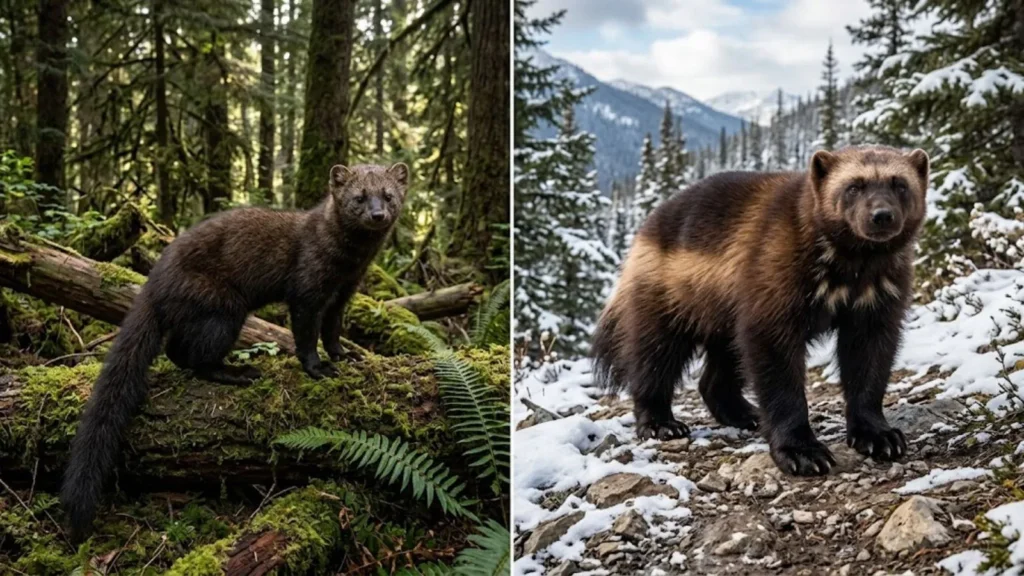
When comparing fisher cat vs wolverine, it is easy to assume these two animals are closely related because both belong to the weasel family. However, they are quite different in size, appearance, habitat, hunting style, and behavior. The fisher, scientifically known as Pekania pennanti, is a medium-sized forest predator found across parts of North America. The wolverine, Gulo gulo, is the largest terrestrial member of the weasel family and is famous for its remarkable strength and endurance.
Both animals are solitary and opportunistic predators. Nevertheless, the fisher vs wolverine comparison becomes especially interesting when you examine their physical abilities, diets, territories, and survival strategies. Understanding these differences also helps explain why each species occupies a different ecological role.
Fisher Cat vs Wolverine: Quick Comparison
The biggest difference between a fisher and a wolverine is size. Fishers are much smaller, while wolverines have a heavier, stockier body built for power.
| Feature | Fisher | Wolverine |
|---|---|---|
| Scientific name | Pekania pennanti | Gulo gulo |
| Family | Mustelidae | Mustelidae |
| Typical weight | About 5–13 pounds | About 13–31 pounds |
| Body type | Long, slim, and agile | Stocky, muscular, and powerful |
| Tail | Long and bushy | Shorter and bushy |
| Habitat | Dense forests | Cold forests, mountains, and alpine regions |
| Lifestyle | Mostly solitary | Mostly solitary |
| Diet | Small mammals, birds, carrion, berries | Mammals, birds, carrion, and other available food |
| Climbing | Excellent | Limited compared with fishers |
| Geographic range | Northern North America | Northern North America and Eurasia |
Fishers can reach roughly 35–47 inches in total length, including the tail, while wolverines can reach around 38–47 inches. Despite similar overall lengths in some individuals, the wolverine is considerably heavier and more heavily built.
What Is a Fisher Cat?
The term fisher cat is a common nickname for the fisher. Despite its name, a fisher is neither a cat nor a specialized fish eater. It is a member of the Mustelidae family, which also includes weasels, otters, martens, and wolverines.
The scientific name of the fisher is Pekania pennanti. It has a long body, short legs, rounded ears, a pointed face, and a large bushy tail. Its coat can range from grayish brown to dark brown or almost black.
Fishers are excellent climbers. Their ability to move through trees gives them access to prey and shelter that many other predators cannot easily reach. They generally prefer mature or dense forests with plenty of cover.
Their diet includes squirrels, hares, mice, birds, and other small animals. Fishers are also famous for their ability to prey on porcupines, making them unusual predators among North American mammals. They may also consume carrion, fruits, nuts, and other foods when available.
What Is a Wolverine?
The wolverine is another member of the Mustelidae family, but it has a very different body design. Its scientific name is Gulo gulo. The species is the largest terrestrial member of the weasel family.
Wolverines have short legs, broad paws, powerful jaws, strong neck muscles, and sharp claws. Their thick fur provides protection against extremely cold conditions. These adaptations make them highly effective in snowy and mountainous environments.
Wolverines are found primarily in Alaska, Canada, and parts of the northern United States. In the Lower 48 states, they are strongly associated with remote mountainous environments and cold, snowy habitats.
Despite their reputation as fierce predators, wolverines often rely heavily on scavenging. They can eat small mammals, birds, eggs, and other available food. They may also feed on large carcasses left by other predators.
Fisher vs Wolverine: Size Difference
Size is one of the clearest differences between these animals.
An adult fisher commonly weighs between 5 and 12 pounds, although larger individuals can exceed that range. Wolverines are substantially heavier, with Yellowstone National Park reporting adults around 13–31 pounds.
A fisher has a relatively slender and flexible body. This shape helps it move quickly through dense vegetation and climb trees.
By contrast, a wolverine has a compact and muscular body. Its powerful shoulders, jaws, and legs give it impressive strength for its size.
Therefore, if you compare a typical fisher cat vs wolverine, the wolverine has a major advantage in weight and physical power.
Fisher Cat vs Wolverine: Appearance
Although both animals have dark brown fur and long tails, their body shapes make them easy to distinguish.
A fisher has:
- A long, narrow body
- Short legs
- Rounded ears
- A long bushy tail
- Dark brown or blackish fur
- A more marten-like appearance
A wolverine looks much stockier. It has a broad head, powerful shoulders, large paws, and a thick body. Its appearance can sometimes remind people of a small bear rather than a typical weasel.
Wolverines may also have lighter markings along the sides of their body, creating a distinctive appearance.
Habitat Differences
Habitat is another major difference in the fisher vs wolverine comparison.
Fishers generally prefer forested environments. They are strongly associated with mature forests that provide trees, fallen logs, cover, and denning opportunities. Their climbing ability also makes forest structure especially important.
Wolverines favor colder and more remote landscapes. They are commonly associated with boreal forests, subalpine areas, alpine terrain, and regions with persistent snow. Females use deep snow for denning, which makes snow conditions especially important for reproduction.
In simple terms, fishers are forest specialists, while wolverines are cold-environment specialists.
Diet and Hunting Behavior
Both species are opportunistic feeders, but their hunting strategies differ.
Fishers actively hunt smaller prey such as squirrels, hares, mice, and birds. Their agility allows them to pursue prey through forests and sometimes into trees. They are also among the few predators capable of effectively hunting porcupines.
Wolverines have a broader reputation for scavenging. Their powerful jaws and teeth allow them to tear through frozen meat and even consume parts of carcasses that many predators cannot use efficiently.
During winter, wolverines may rely heavily on carrion. They can travel enormous distances to locate food and may cache food for later consumption.
Which Is Stronger: Fisher or Wolverine?
If the question is fisher vs wolverine strength, the wolverine is the clear winner.
The fisher is an impressive predator for its size, but the wolverine is much heavier and more muscular. Its powerful jaws, strong claws, broad paws, and robust body give it exceptional physical strength.
Wolverines have even been documented killing prey much larger than themselves, although scavenging remains an important part of their lifestyle.
A fisher’s advantage comes from speed, agility, and climbing ability, whereas the wolverine’s advantage comes from strength, endurance, and powerful physical adaptations.
Would a Fisher and Wolverine Fight?
A direct encounter between a fisher and a wolverine would be unusual because they generally occupy different habitats and ecological niches.
If such an encounter occurred, the wolverine would have a substantial advantage because of its greater body mass and strength. However, wildlife encounters should not be treated like predictable contests. Animals usually avoid unnecessary fights because injuries can reduce their ability to hunt and survive.
The fisher’s best defenses would be agility, speed, and its ability to use forest cover or climb.
Fisher Cat vs Wolverine: Who Would Win?
If you are asking purely about physical power, the wolverine would almost certainly have the advantage.
The wolverine is larger, heavier, stronger, and equipped with powerful jaws and claws. The fisher is much smaller but remains an effective predator because it relies on stealth, flexibility, speed, and climbing ability.
So, in a hypothetical confrontation:
Winner in strength: Wolverine
Winner in size: Wolverine
Winner in climbing: Fisher
Winner in agility: Fisher
Winner in overall physical power: Wolverine
However, these comparisons are hypothetical. In nature, the two species rarely need to compete directly.
Fisher vs Wolverine: Geographic Range
Fishers occur across parts of Canada and the northern United States, particularly in forested regions. Their populations have faced historical pressure from trapping and habitat loss, although conservation and restoration efforts have helped the species return to some areas.
Wolverines have a much broader global distribution. They occur across northern regions of North America, Europe, and Asia. In the contiguous United States, their populations are concentrated mainly in remote mountainous areas.
Wolverines also occur at very low population densities because individual animals require large home ranges.
Conservation and Threats
Both animals depend on healthy ecosystems, but their conservation challenges differ.
Fishers can be affected by habitat loss, forest fragmentation, roads, and historical trapping. Maintaining connected forests helps provide the cover and resources they need.
Wolverines face particular challenges because they depend on large, remote landscapes and cold, snowy conditions. Climate change may reduce suitable snow conditions for denning in parts of their range.
Protecting large natural areas benefits both species while also supporting countless other wildlife species.
Frequently Asked Questions
Is a fisher cat the same as a wolverine?
No. A fisher and a wolverine are different species. Both belong to the weasel family, but the wolverine is considerably heavier and more powerful.
Is a fisher cat bigger than a wolverine?
No. Wolverines are generally much heavier. Fishers usually weigh around 5–13 pounds, while adult wolverines can weigh considerably more.
Are fisher cats dangerous?
Fishers are wild predators and should be treated with caution. However, they generally avoid people. They are more interested in finding food and shelter than confronting humans.
Can a fisher climb trees?
Yes. Fishers are highly capable climbers. Their climbing skills help them move through forest habitats and access prey or shelter.
Is a wolverine stronger than a fisher?
Yes. The wolverine has a substantial advantage in body weight, muscle mass, jaw strength, and overall physical power.
Do fisher cats eat fish?
Despite the name, fishers do not primarily eat fish. Their diet includes small mammals, birds, carrion, and other foods.
Conclusion
The fisher cat vs wolverine comparison reveals two fascinating members of the weasel family with very different survival strategies. Fishers are smaller, agile forest predators that excel at climbing and hunting small prey. Wolverines are larger, stronger animals adapted to cold, snowy, and remote environments.
While the wolverine clearly dominates in size and physical strength, the fisher has impressive agility and climbing abilities. Neither animal is simply “better” in nature. Each species has evolved specialized traits that help it survive in its own environment.
Understanding these differences makes wildlife more fascinating. From the fisher’s stealthy movements through dense forests to the wolverine’s incredible endurance across snowy mountains, both animals play important roles in their ecosystems and deserve protection.