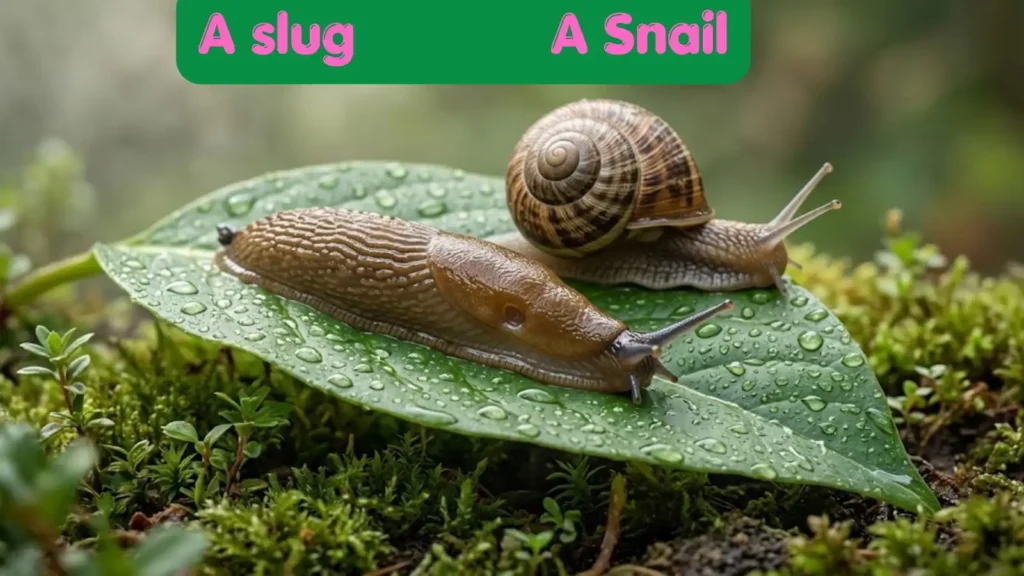
Imagine finding a soft, shiny creature sliding across a wet garden path after rain. At first glance, it looks exactly like a snail—but something seems missing: the shell. That naturally raises the question, is a slug a snail without a shell?
The short answer is almost, but not quite. Slugs and snails both belong to the class Gastropoda, and they share many important biological features. However, “slug” is a common name used for several different evolutionary groups rather than a single scientific category. Most land slugs lack a visible external shell, while some retain a tiny internal or reduced shell.
So, a slug is not simply an ordinary snail that lost its shell during its lifetime. Instead, slugs evolved from shelled gastropod ancestors, with shell reduction occurring independently in several lineages. This fascinating evolutionary change gave slugs a distinctive body shape and lifestyle.
See also: Dreaming Wild Animals
Is a Slug a Snail Without a Shell?
Yes, in a broad everyday sense, a slug resembles a snail without a visible shell. However, scientifically, slugs are shell-reduced gastropods rather than ordinary snails that have misplaced their shells.
Both animals are gastropod mollusks, meaning they share a muscular foot, soft body, tentacles, and a specialized feeding organ called a radula. The major visible difference is the shell.
A typical land snail carries a large calcium-carbonate shell that protects its body. A slug usually has no obvious external shell. Some species, however, retain a small internal shell beneath the mantle.
Why Did Slugs Lose Their Shells?
Evolution did not simply “remove” the shell overnight. Instead, shell reduction happened gradually and independently among different gastropod groups.
Scientists suggest that losing a large shell can provide several advantages:
- Less calcium and energy are required for shell production.
- A smaller body can squeeze through narrow spaces.
- A shell-less body can make underground movement easier.
- Some slugs developed alternative defensive adaptations.
- Reduced weight can benefit certain crawling and burrowing lifestyles.
Shell production carries biological costs because calcium and metabolic energy are required to build and maintain it.
Scientific Classification
Slugs belong to Kingdom Animalia, Phylum Mollusca, and Class Gastropoda. Unlike a single taxonomic group, “slug” describes shell-less or shell-reduced gastropods from multiple evolutionary lineages.
| Classification | Slug |
|---|---|
| Kingdom | Animalia |
| Phylum | Mollusca |
| Class | Gastropoda |
| Body type | Soft-bodied invertebrate |
| Shell | Absent, internal, or highly reduced |
| Movement | Muscular foot |
| Feeding organ | Radula |
Importantly, slugs do not form one neat scientific family. Several unrelated gastropod lineages independently evolved slug-like forms, making the word “slug” a convenient common name rather than a strict taxonomic group.
Physical Characteristics
A slug looks simple, but its body contains several specialized structures that help it sense, feed, breathe, and move efficiently.
Most terrestrial slugs have a long, soft body covered with mucus. Their muscular foot stretches along the underside and produces the crawling motion.
Common features include:
- Two pairs of tentacles in many land species
- Eyes or eyespots on the upper tentacles
- Shorter sensory tentacles
- A broad muscular foot
- A mantle covering part of the body
- A mucus-producing surface
- A radula for scraping food
The mucus layer helps reduce friction while also limiting moisture loss. The upper tentacles generally detect light and movement, while the lower pair helps with touch and chemical sensing.
Habitat and Distribution
After rain, slugs emerge because damp conditions reduce the danger of dehydration and make travel across surfaces easier.
Land slugs occur in many environments, including:
- Forest floors
- Gardens
- Grasslands
- Leaf litter
- Agricultural fields
- Compost areas
- Damp soil
- Areas beneath rocks and logs
Many species remain hidden during hot, dry periods and become active during cool nights or wet weather. Their dependence on moisture makes humidity an important factor in slug activity.
Not every slug lives on land, either. Sea slugs represent numerous marine gastropod groups, including spectacular nudibranchs. Some have no shell at all, while others retain highly reduced internal structures.
Diet and Hunting Behavior
Despite their reputation as garden pests, slugs have surprisingly varied diets and can perform useful ecological work.
Many terrestrial slugs consume:
- Fallen leaves
- Fungi
- Algae
- Decaying vegetation
- Dead insects
- Soft plant tissues
- Organic debris
Some species also attack living garden plants, particularly young seedlings and tender leaves. They scrape food with a radula, a ribbon-like feeding structure equipped with numerous tiny teeth.
However, calling every slug a destructive pest would be misleading. Many species act as decomposers, helping recycle organic matter and returning nutrients to soil ecosystems.
Reproduction and Lifespan
Slug reproduction is another reminder that these soft-bodied animals are biologically more sophisticated than they appear.
Many terrestrial slugs are hermaphrodites, meaning an individual possesses both male and female reproductive organs. However, reproductive strategies vary among species.
Slugs lay clusters of eggs in protected, damp locations such as soil, leaf litter, or sheltered crevices. Depending on species and conditions, young slugs may emerge during favorable seasons.
Lifespan also varies considerably. Some slugs live around a year, while certain species can survive several years under suitable conditions.
Behavior and Adaptations
A shell may be missing, but slugs compensate with an impressive collection of behavioral and physiological adaptations.
Their most obvious adaptation is mucus production. The slippery secretion helps slugs glide across surfaces and protects their exposed skin from excessive drying.
Other adaptations include:
- Nocturnal activity
- Hiding beneath debris
- Burrowing into soil
- Producing defensive mucus
- Using chemical senses to locate food
- Remaining inactive during unfavorable weather
Marine slugs can display even more unusual defenses. Some species have evolved chemical defenses, specialized surface structures, or other mechanisms that discourage predators.
Threats and Conservation Status
Although common garden slugs rarely attract conservation concern, some slug species face serious ecological pressures.
Threats can include:
- Habitat destruction
- Soil disturbance
- Pollution
- Pesticide exposure
- Invasive species
- Climate-related changes
- Loss of moist microhabitats
Because different slug species have different distributions and ecological requirements, their conservation status cannot be generalized. Some species are widespread, while specialized species may have restricted ranges.
Therefore, people should avoid treating every slug as an unwanted pest. Many contribute to nutrient cycling and serve as prey for birds, amphibians, reptiles, beetles, and other wildlife.
Interesting Facts
The humble slug hides several evolutionary surprises that make it far more interesting than its garden reputation suggests.
- Some slugs possess a tiny internal shell.
- Shell reduction evolved multiple times independently.
- Slugs and snails are both gastropods.
- Many slugs use a radula to scrape food.
- Slug mucus helps reduce friction.
- Some species can survive for several years.
- Sea slugs include brilliantly colored marine animals.
- Slugs provide food for numerous predators.
- Not every slug eats living plants.
- Some slug species spend much of their lives underground.
The most surprising fact is perhaps that some slugs are more closely related to certain snails than to other animals commonly called slugs. This happens because shell loss evolved repeatedly in different gastropod lineages.
Bugs vs Insects Examples
The words “bug” and “insect” often overlap in everyday speech, but they do not mean exactly the same thing scientifically.
Examples of insects include:
- Butterflies
- Beetles
- Ants
- Bees
- Flies
- Grasshoppers
True bugs belong specifically to the insect order Hemiptera. Aphids, cicadas, stink bugs, and leafhoppers are examples of true bugs.
A slug, meanwhile, is neither a bug nor an insect. It belongs to Mollusca rather than Arthropoda.
Difference Between Bugs and Insects for Preschoolers
Think of insects as a big animal group, while “true bugs” are one smaller group inside it.
An insect usually has:
- Six legs
- Three main body sections
- Two antennae
- Often wings
A slug has:
- No legs
- One soft, elongated body
- Tentacles
- A muscular foot
- No visible external shell in most species
Therefore, a slug is completely different from an insect.
Are Spiders Bugs or Insects?
Spiders are neither true bugs nor insects; they belong to a separate group called arachnids.
Spiders have eight legs, while insects have six. They also lack the three-part body arrangement typical of insects.
Other arachnids include:
- Scorpions
- Ticks
- Mites
- Harvestmen
A slug belongs to yet another major animal group: Mollusca.
Are All Bugs Insects?
All true bugs are insects, but not all insects are true bugs.
In everyday language, people often call many small crawling animals “bugs.” Scientifically, however, the term true bug refers to members of Hemiptera.
For example, a beetle is an insect but not a true bug. A spider is neither. A slug is neither.
Bugs and Insects List
This quick comparison makes the differences easier to remember.
| Animal | Insect? | True Bug? | Arachnid? | Mollusk? |
|---|---|---|---|---|
| Ant | Yes | No | No | No |
| Butterfly | Yes | No | No | No |
| Beetle | Yes | No | No | No |
| Aphid | Yes | Yes | No | No |
| Spider | No | No | Yes | No |
| Scorpion | No | No | Yes | No |
| Slug | No | No | No | Yes |
| Snail | No | No | No | Yes |
Bugs vs Insects Characteristics
Body structure provides the clearest way to distinguish these groups without relying on common names.
| Feature | Insects | True Bugs | Slugs | Spiders |
|---|---|---|---|---|
| Legs | 6 | 6 | None | 8 |
| Main group | Arthropoda | Arthropoda | Mollusca | Arachnida |
| Body | 3 sections | 3 sections | Soft, elongated | 2 main regions |
| Antennae | Usually 2 | 2 | Tentacles instead | None |
| External skeleton | Yes | Yes | No | Yes |
| Shell | No | No | Usually absent/reduced | No |
Insect vs Bug vs Arachnid
The simplest distinction is anatomical: insects have six legs, arachnids have eight, while slugs have no walking legs at all.
Remember these three points:
- Insect: six legs and three main body sections.
- True bug: an insect belonging to Hemiptera.
- Arachnid: eight legs and no antennae.
- Slug: a soft-bodied gastropod with a muscular foot.
This classification prevents a common mistake: calling every small crawling creature a “bug.”
Is a Slug a Snail Without a Shell? Summary
A slug is best described as a shell-less or shell-reduced gastropod, not simply a regular snail that has lost its shell.
Both slugs and snails belong to Gastropoda and share important structures such as muscular feet, sensory tentacles, mucus, and radulae. However, many slugs evolved from shelled ancestors and gradually reduced their shells. Some retain internal shell remnants.
So, if someone asks, “Is a slug a snail without a shell?”, the easiest answer is:
A slug is a type of gastropod related to snails, usually without a visible external shell. It is not simply an ordinary snail that lost its shell.
FAQs
Is a slug just a snail without a shell?
Not exactly. A slug is a shell-less or shell-reduced gastropod. Several slug lineages evolved independently from shelled ancestors.
Do slugs have shells inside their bodies?
Some slugs have small internal or vestigial shells, while others have lost shells almost completely. The internal shell may sit beneath the mantle.
Are slugs related to snails?
Yes. Slugs and snails both belong to the gastropod class of mollusks. However, different slug groups are not necessarily closely related to one another.
What do slugs eat?
Many slugs eat fungi, algae, decaying vegetation, leaves, and other organic material. Some species also consume living garden plants.
Why do slugs come out after rain?
Wet conditions reduce dehydration risk and make movement easier. Consequently, slugs often become more active during rainy weather and humid nights.
Conservation Awareness
Every slug has a place in the food web, even when it occasionally damages a garden plant. Many species recycle organic matter and provide food for birds, amphibians, reptiles, and predatory insects.
Instead of removing every slug indiscriminately, identify the species and understand its ecological role first. In gardens, practical approaches such as reducing excessive moisture around vulnerable plants, removing hiding debris, and protecting seedlings can limit damage without unnecessarily harming wildlife.
A creature without a shell may look defenseless, but the slug represents an extraordinary evolutionary experiment. Its streamlined body, mucus-based movement, sensory tentacles, and shell-reduction adaptations show how wildlife can survive by taking a completely different evolutionary route.
Protecting small creatures such as slugs also means protecting the intricate ecosystems that depend on them.