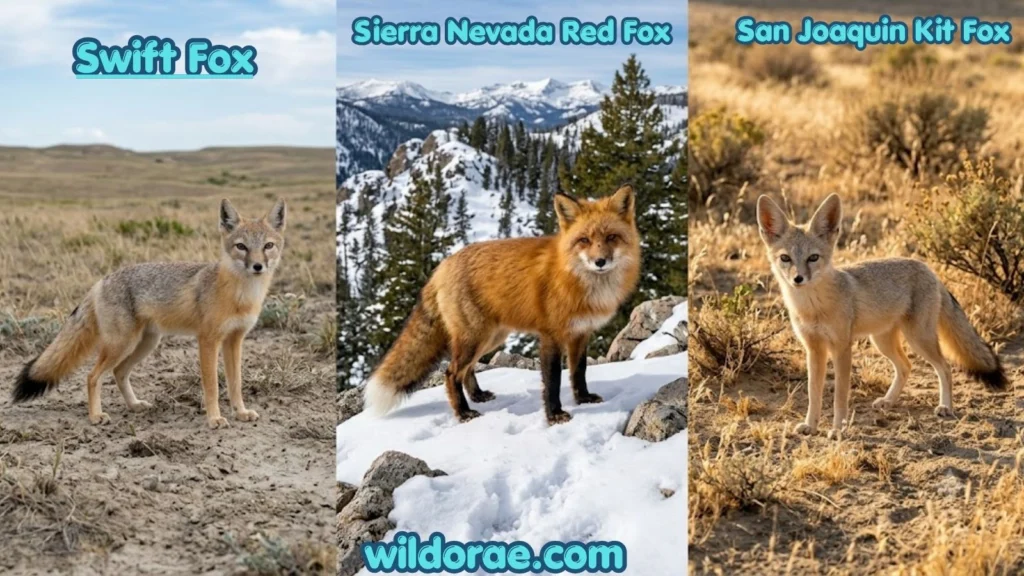
Imagine spotting a small fox racing across a prairie, another sneaking through snowy mountain forests, and a third slipping quietly across dry California grasslands. At first glance, they may seem alike. However, each species has evolved for a very different world.
The Swift Fox vs Sierra Nevada Red Fox vs San Joaquin Kit Fox comparison highlights three remarkable North American foxes with unique survival skills. Although all belong to the dog family, they differ in size, habitat, hunting style, and conservation status. Understanding these differences helps wildlife enthusiasts, students, and nature lovers appreciate their role in healthy ecosystems.
This guide explores their scientific classification, appearance, habitat, diet, reproduction, behavior, threats, and fascinating facts. You’ll also find a quick comparison table, practical wildlife tips, and answers to common questions.
See Also: Bird Rescue in San Antonio
Quick Comparison Table
| Feature | Swift Fox | Sierra Nevada Red Fox | San Joaquin Kit Fox |
|---|---|---|---|
| Scientific Name | Vulpes velox | Vulpes vulpes necator | Vulpes macrotis mutica |
| Average Weight | 4–7 lbs | 6–10 lbs | 3.5–6 lbs |
| Habitat | Great Plains grasslands | High Sierra mountains | California grasslands and deserts |
| Active Time | Mostly night | Dawn and dusk | Mostly night |
| Main Diet | Rodents, insects | Small mammals, birds | Kangaroo rats, rabbits, insects |
| Conservation | Least Concern | Endangered population | Endangered |
REALTED: Wildlife Photography Internship
Scientific Classification
Although these foxes share the same family, they belong to different branches of the fox family tree.
| Classification | Swift Fox | Sierra Nevada Red Fox | San Joaquin Kit Fox |
|---|---|---|---|
| Kingdom | Animalia | Animalia | Animalia |
| Phylum | Chordata | Chordata | Chordata |
| Class | Mammalia | Mammalia | Mammalia |
| Order | Carnivora | Carnivora | Carnivora |
| Family | Canidae | Canidae | Canidae |
| Genus | Vulpes | Vulpes | Vulpes |
| Species | Vulpes velox | Vulpes vulpes | Vulpes macrotis |
While the Swift Fox vs Sierra Nevada Red Fox vs San Joaquin Kit Fox comparison shows close relatives, their evolutionary paths adapted them to very different environments.
Physical Characteristics
Appearance provides one of the easiest ways to tell these foxes apart.
Swift Fox
The Swift Fox is compact with sandy-gray fur, a black-tipped tail, and relatively short ears. It has long legs that help it sprint across open prairies.
Sierra Nevada Red Fox
The Sierra Nevada Red Fox looks much fluffier. Thick reddish fur, white chest markings, and bushy tails help it survive freezing alpine winters.
San Joaquin Kit Fox
The San Joaquin Kit Fox has oversized ears, a slender body, and pale gray or tan fur. Its ears release excess heat, making desert survival much easier.
Size Comparison
- Largest: Sierra Nevada Red Fox
- Fastest runner: Swift Fox
- Lightest: San Joaquin Kit Fox
- Largest ears: San Joaquin Kit Fox
Habitat and Distribution
Each fox occupies a specialized habitat that matches its unique survival strategy.
Swift Fox Habitat
Swift Foxes roam the open grasslands of:
- Montana
- Wyoming
- Colorado
- Kansas
- Oklahoma
- New Mexico
- Texas
Flat terrain allows them to detect predators from long distances.
Sierra Nevada Red Fox Habitat
These rare foxes live only in high-elevation mountain regions, including:
- Sierra Nevada Mountains
- Lassen Peak region
They often occupy forests above 7,000 feet where snow covers the ground for much of the year.
San Joaquin Kit Fox Habitat
This endangered fox survives mainly within California’s:
- San Joaquin Valley
- Dry shrublands
- Desert grasslands
- Agricultural edges
Their underground dens provide shelter from extreme heat.
Diet and Hunting Behavior
Food choices reflect each species’ environment.
Swift Fox Diet
Swift Foxes feed on:
- Prairie dogs
- Mice
- Ground squirrels
- Grasshoppers
- Beetles
- Birds
- Fruits
They actively chase prey in open fields.
Sierra Nevada Red Fox Diet
Mountain habitats offer different food sources:
- Snowshoe hares
- Small rodents
- Birds
- Eggs
- Carrion
- Seasonal berries
Heavy snowfall often changes their hunting patterns.
San Joaquin Kit Fox Diet
Desert conditions require flexibility.
Common prey includes:
- Kangaroo rats
- Pocket mice
- Rabbits
- Lizards
- Insects
- Occasionally birds
They rely heavily on hearing to locate animals underground.
Reproduction and Lifespan
Despite their differences, these foxes follow similar breeding cycles.
Breeding
- Mating occurs during winter.
- Females give birth in spring.
- Litters usually contain 3–6 pups.
- Parents share pup care.
Average Lifespan
| Species | Wild Lifespan |
|---|---|
| Swift Fox | 3–6 years |
| Sierra Nevada Red Fox | 5–8 years |
| San Joaquin Kit Fox | 5–7 years |
Disease, predators, and habitat quality greatly influence survival.
Behavior and Adaptations
One fascinating aspect of the Swift Fox vs Sierra Nevada Red Fox vs San Joaquin Kit Fox comparison involves their specialized adaptations.
Swift Fox Adaptations
- Extremely fast runner
- Uses abandoned burrows
- Excellent night vision
- Sharp hearing
These traits reduce predator encounters.
Sierra Nevada Red Fox Adaptations
- Thick insulating fur
- Broad paws for snow travel
- Excellent climbing ability
- Strong sense of smell
Cold mountain weather shaped every feature.
San Joaquin Kit Fox Adaptations
- Oversized ears regulate body temperature.
- Large underground dens remain cool.
- Lightweight body conserves energy.
- Quiet movements improve hunting success.
Threats and Conservation Status
Unfortunately, all three species face growing environmental pressures.
Swift Fox
Primary threats include:
- Habitat loss
- Prairie conversion
- Coyotes
- Vehicle collisions
Conservation efforts have restored populations across several states.
Sierra Nevada Red Fox
This fox remains one of North America’s rarest mammals.
Major threats include:
- Climate change
- Small population size
- Habitat fragmentation
- Genetic isolation
Researchers continue monitoring its tiny population.
San Joaquin Kit Fox
The San Joaquin Kit Fox faces serious challenges:
- Urban expansion
- Agriculture
- Road mortality
- Disease
- Predator competition
Protected habitats remain essential for its future.
Conservation Status Overview
| Species | Status |
|---|---|
| Swift Fox | Least Concern (recovering locally) |
| Sierra Nevada Red Fox | Endangered population |
| San Joaquin Kit Fox | Federally Endangered |
Interesting Facts
Here are some surprising discoveries about these remarkable foxes.
- Swift Foxes can run nearly 40 miles per hour.
- Sierra Nevada Red Foxes live higher than almost any other North American fox.
- San Joaquin Kit Foxes often create multiple escape dens.
- All three species rely heavily on hearing during hunts.
- Foxes help control rodent populations naturally.
- They spread seeds by eating fruits and later dispersing them.
Benefits to the Ecosystem
Many people overlook how valuable foxes are.
These species help by:
- Controlling rodent populations
- Reducing agricultural pests
- Supporting ecosystem balance
- Providing food for larger predators
- Maintaining biodiversity
Healthy fox populations often indicate healthy habitats.
Safety Around Wild Foxes
Wild foxes rarely threaten people.
If you encounter one:
- Observe quietly.
- Keep pets leashed.
- Never feed wildlife.
- Stay several yards away.
- Report injured animals to wildlife authorities.
Respecting natural behavior keeps both humans and foxes safe.
Practical Wildlife Watching Tips
Seeing these foxes requires patience.
For better chances:
- Visit habitats during dawn or dusk.
- Bring binoculars.
- Wear neutral-colored clothing.
- Stay silent.
- Avoid approaching dens.
- Leave no trash behind.
Responsible wildlife viewing protects sensitive populations.
Simple Habitat Diagram
North America

Grasslands
     │
     ├── Swift Fox

High Mountains
     │
     ├── Sierra Nevada Red Fox

California Valleys & Deserts
     │
     └── San Joaquin Kit Fox
Summary
The Swift Fox vs Sierra Nevada Red Fox vs San Joaquin Kit Fox comparison shows how closely related animals can evolve into specialists for entirely different environments. The Swift Fox thrives in open prairies with incredible speed. The Sierra Nevada Red Fox survives harsh mountain winters using thick fur and alpine adaptations. Meanwhile, the San Joaquin Kit Fox depends on oversized ears, underground dens, and desert survival skills. Protecting these foxes preserves biodiversity and strengthens North America’s natural ecosystems.
Frequently Asked Questions
Which fox is the rarest?
The Sierra Nevada Red Fox is considered one of North America’s rarest fox populations due to its extremely small numbers and limited mountain habitat.
Is the San Joaquin Kit Fox endangered?
Yes. The San Joaquin Kit Fox is federally listed as endangered because habitat loss and urban development continue reducing its population.
Which fox is the fastest?
The Swift Fox is the fastest among these three species, reaching speeds close to 40 mph across open grasslands.
Do these foxes hunt during the day?
Most are primarily nocturnal or active during dawn and dusk, helping them avoid predators and extreme temperatures.
Why are these foxes important?
They naturally control rodents, support healthy ecosystems, spread seeds, and contribute to biodiversity across North America.
Conservation Awareness
Every protected grassland, mountain forest, and desert habitat gives these remarkable foxes another chance to survive. Support wildlife conservation organizations, respect protected areas, and never disturb wild animals or their dens. Small actions today can help ensure future generations continue seeing the Swift Fox, Sierra Nevada Red Fox, and San Joaquin Kit Fox thriving in the wild.