Have you ever called a spider a bug, then wondered whether that was scientifically correct? You are certainly not alone. Everyday language uses bug for almost any tiny crawling creature, while biology gives the word a much narrower meaning. Understanding bugs vs insects becomes easier once you look at their body structure, mouthparts, classification, and life cycles.
In simple terms, all true bugs are insects, but not all insects are true bugs. True bugs belong to the order Hemiptera, while insects include thousands of other groups such as beetles, butterflies, ants, bees, and flies. Smithsonian resources explain that true bugs have specialized piercing-and-sucking mouthparts, while insects share basic features such as six legs, three body regions, and antennae.
See also: Wilderness Wildlife Center Bulger PARK
Bugs vs insects examples
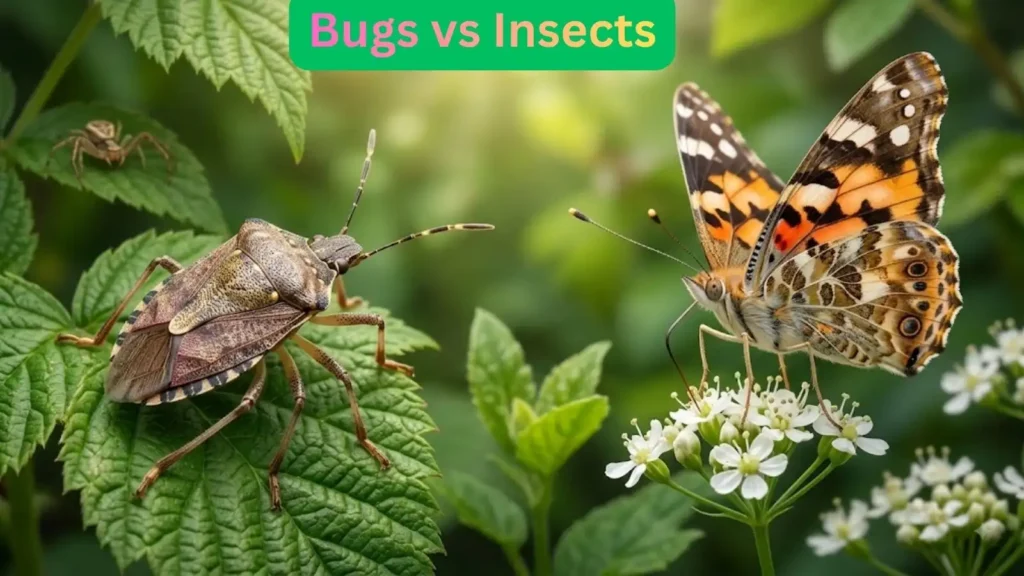
Examples make the distinction much clearer. A ladybug is an insect but technically a beetle, while a stink bug is a true bug belonging to Hemiptera.
| Animal | Insect? | True bug? | Group |
|---|---|---|---|
| Stink bug | Yes | Yes | Hemiptera |
| Aphid | Yes | Yes | Hemiptera |
| Cicada | Yes | Yes | Hemiptera |
| Bed bug | Yes | Yes | Hemiptera |
| Butterfly | Yes | No | Lepidoptera |
| Beetle | Yes | No | Coleoptera |
| Honeybee | Yes | No | Hymenoptera |
| Grasshopper | Yes | No | Orthoptera |
| Housefly | Yes | No | Diptera |
| Spider | No | No | Arachnida |
True bugs include cicadas, aphids, bed bugs, and many plant and predatory species. Their mouthparts form a specialized beak-like structure for piercing and sucking liquids.
Difference between bugs and insects for preschoolers
Think of insects as a big family, while true bugs form one smaller family inside it. This simple comparison helps children understand the difference.
- Insects: Usually have six legs.
- True bugs: Are insects with specialized piercing-and-sucking mouthparts.
- Spiders: Have eight legs and are not insects.
- Butterflies: Are insects, but they are not true bugs.
- Ladybugs: Are beetles, despite having “bug” in their common name.
A child-friendly rule is simple: six legs usually means insect, but “bug” does not always mean true bug. Smithsonian educators use the three-part body structure and six legs as major clues for identifying insects.
Are spiders bugs or insects
Spiders may look bug-like, but their anatomy tells a different story. This belong to the class Arachnida, whereas insects belong to the class Insecta.
Spiders have:
- Eight legs
- Two main body regions
- No antennae
- No wings
- Specialized silk-producing structures
In contrast, insects generally have six legs, three major body regions, and one pair of antennae. Therefore, calling a spider a “bug” works casually, but calling it an insect is scientifically incorrect.
Spiders are nevertheless important wildlife because they prey on insects and other small animals. Their hunting behavior can naturally suppress populations of many arthropods.
Are all bugs insects
Scientifically, true bugs are insects, but everyday English uses “bug” much more loosely. This difference causes most confusion surrounding bugs vs insects.
The scientific term true bug generally refers to members of Hemiptera. These insects include aphids, cicadas, leafhoppers, stink bugs, assassin bugs, and bed bugs.
However, people commonly use “bug” for:
- Spiders
- Beetles
- Cockroaches
- Centipedes
- Millipedes
- Flies
- Moths
That informal usage does not change their scientific classification. Smithsonian Gardens summarizes the distinction neatly: people often call insects bugs, but true bugs specifically belong to Hemiptera.
Bugs and insects list
A quick list reveals how broad the insect world really is. Many familiar creatures belong to different insect orders despite sharing similar body plans.
Common true bugs
- Aphids
- Cicadas
- Stink bugs
- Bed bugs
- Assassin bugs
- Leafhoppers
- Water striders
- Shield bugs
- Plant bugs
Common insects that are not true bugs
- Butterflies
- Moths
- Beetles
- Bees
- Wasps
- Ants
- Grasshoppers
- Crickets
- Dragonflies
- Mosquitoes
- Houseflies
Beetles belong to Coleoptera, flies belong to Diptera, and bees, ants, and wasps belong to Hymenoptera.
Bugs vs insects characteristics
Body structure provides the strongest clue when identifying an unfamiliar arthropod. Look closely at legs, antennae, body regions, wings, and feeding structures.
| Characteristic | Insects | True bugs |
|---|---|---|
| Scientific class | Insecta | Insecta |
| Main group | Many orders | Hemiptera |
| Legs | Six | Six |
| Body regions | Head, thorax, abdomen | Head, thorax, abdomen |
| Antennae | One pair | One pair |
| Mouthparts | Vary by group | Piercing and sucking |
| Wings | Variable | Often two pairs |
| Metamorphosis | Complete or incomplete | Usually incomplete |
True bugs have distinctive sucking mouthparts. Many feed on plant sap, while predatory species capture other small animals, and some parasitic forms consume blood.
Scientific Classification
Insects belong to Arthropoda and class Insecta; true bugs belong within Hemiptera, while spiders belong to Arachnida, another arthropod class.
Physical Characteristics
Most insects have six jointed legs, three body regions, antennae, and an external skeleton; wings vary widely among different insect groups.
Habitat and Distribution
Insects occupy forests, grasslands, deserts, wetlands, gardens, freshwater habitats, and even some marine environments, showing remarkable ecological flexibility.
Diet and Hunting Behavior
Their diets range from nectar and plant sap to decaying matter and prey, while predatory species use speed, camouflage, traps, or piercing mouthparts.
Reproduction and Lifespan
Insects reproduce through eggs and diverse developmental patterns; some undergo complete metamorphosis, while true bugs generally develop through gradual, incomplete metamorphosis.
Behavior and Adaptations
Camouflage, mimicry, flight, chemical defenses, social behavior, and seasonal dormancy help insects survive predators, weather changes, scarce food, and competing species.
Threats and Conservation Status
Individual insect species face habitat loss, pollution, pesticides, invasive species, disease, and climate change, although conservation status differs greatly among species.
Interesting Facts
Some insects pollinate crops, recycle nutrients, control pests, and feed countless wildlife species, making these tiny creatures ecological powerhouses rather than mere nuisances.
Insect vs bug vs arachnid
Three groups become easier to separate when you compare their anatomy side by side.
| Feature | Insect | True bug | Arachnid |
|---|---|---|---|
| Example | Butterfly | Stink bug | Spider |
| Legs | 6 | 6 | 8 |
| Body regions | 3 | 3 | Usually 2 |
| Antennae | Yes | Yes | No |
| Wings | Some species | Often present | No |
| Scientific class | Insecta | Insecta | Arachnida |
The biggest distinction is that true bugs are insects, while arachnids form a separate arthropod class. Spiders, scorpions, ticks, and mites belong to Arachnida.
Why bugs and insects matter to wildlife
Look beyond the bite, buzz, or crawl, and you will discover an intricate ecological workforce. Insects pollinate plants, recycle nutrients, provide prey, and sometimes control populations of other organisms.
Pollinating insects are especially valuable. The U.S. Department of Agriculture notes that roughly three-fourths of flowering plants and about 35% of food crops depend on animal pollinators.
Insects also support birds, reptiles, amphibians, fish, and mammals. Meanwhile, decomposing insects help return nutrients from dead organic material to the ecosystem.
Benefits and practical wildlife tips
A wildlife-friendly garden can support insects without turning your home into a pest zone.
Try these practical steps:
- Plant native flowering species.
- Avoid unnecessary broad-spectrum pesticides.
- Leave some leaf litter for decomposers.
- Provide shallow water sources where appropriate.
- Grow plants that bloom during different seasons.
- Avoid destroying harmless insects simply because they look unfamiliar.
- Learn to identify species before using pest-control products.
However, some insects can damage crops, spread disease, or cause painful bites and stings. Responsible identification helps you choose the right response.
Safety around biting insects
When insects become a health concern, prevention matters more than panic. Wear suitable clothing, avoid disturbing nests, and follow product directions when using repellents.
The U.S. Environmental Protection Agency recommends reading repellent labels carefully, applying products only as directed, avoiding eyes and mouth, and keeping repellents away from children when not supervised.
Never assume every crawling creature requires chemical treatment. Many harmless species perform useful ecological work.
Summary
Bugs vs insects sounds like a simple comparison, yet the terminology hides an important scientific distinction. Insects form the class Insecta, while true bugs are insects within Hemiptera.
Remember these key points:
- Every true bug is an insect.
- Not every insect is a true bug.
- True bugs have piercing-and-sucking mouthparts.
- Spiders are arachnids, not insects.
- Insects have six legs.
- Arachnids have eight legs.
- Insects support pollination, decomposition, food webs, and natural pest control.
FAQs About Bugs vs Insects
Are bugs and insects the same thing?
No. In everyday speech, people often use “bug” for many small creatures. Scientifically, true bugs are insects belonging to Hemiptera, so not every insect is a true bug.
Is a butterfly a bug or an insect?
A butterfly is an insect, but it is not a true bug. Butterflies belong to the order Lepidoptera and undergo complete metamorphosis.
Is a ladybug a true bug?
No. Despite its common name, a ladybug is a beetle. It belongs to Coleoptera rather than Hemiptera.
Why are spiders not insects?
Spiders are not insects because they have eight legs, two main body regions, and no antennae. They belong to Arachnida.
What is the easiest way to identify an insect?
Start with the legs. An insect has six jointed legs, while an adult spider has eight. Then check the body regions, antennae, wings, and mouthparts.
Conservation Message
Small creatures deserve big respect. Whether a species is a pollinator, predator, decomposer, or food source, insects help maintain functioning ecosystems. Protect native plants, reduce unnecessary pesticide use, preserve natural habitats, and observe wildlife before removing it.
Learning the difference between bugs vs insects is more than a vocabulary exercise. It is a doorway into understanding the extraordinary machinery of nature—and recognizing why even the tiniest creatures deserve a place in the wild.