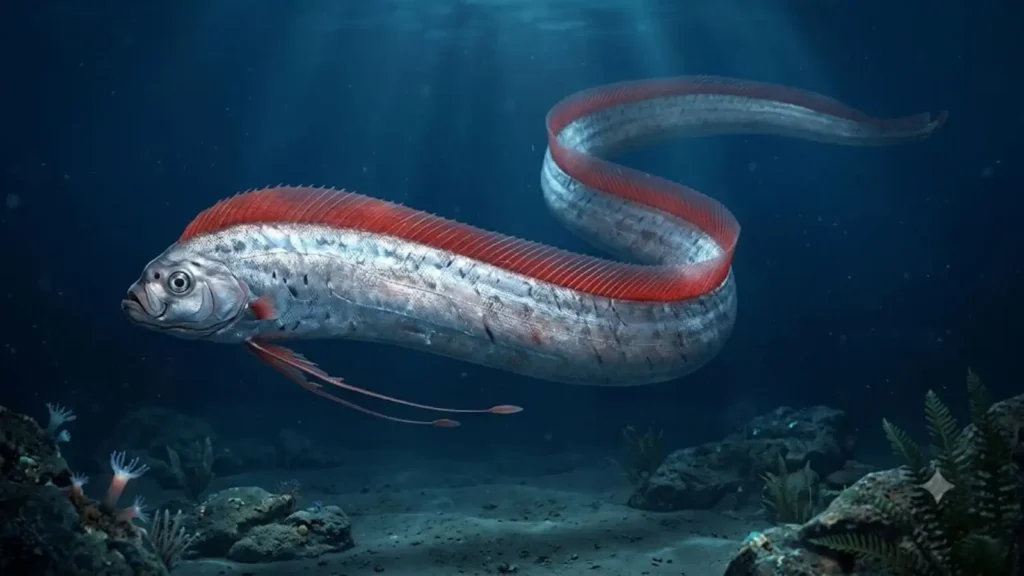
The ocean is full of creatures that can make even experienced marine experts stop and stare. Among the strangest is the giant oarfish, a long, silver fish that can grow to around 8 meters in length. With its ribbon-shaped body, flowing red fin, and unusual movements, it looks remarkably similar to a giant sea serpent. For centuries, mysterious sightings of these fish have inspired frightening stories and legends. In some places, people even call them “harbingers of doom” because of an old belief that their appearance signals earthquakes or tsunamis. But is there any truth behind this terrifying reputation? The real story of the giant oarfish is far more fascinating than the myth.
See also: Wilderness Wildlife Center Bulger PA
Giant Oarfish
The giant oarfish is a mysterious deep-sea fish famous for its extraordinary length, silver body, red fins, and serpent-like appearance.
Why Are Oarfish Called Doomsday Fish?
Oarfish are called doomsday fish because folklore connects their rare appearances near shore with earthquakes, tsunamis, and other disasters.
Largest Giant Oarfish Ever Found
The largest giant oarfish records reveal an astonishing marine animal, with some reported specimens reaching remarkable lengths beyond ordinary expectations.
56 Ft Giant Oarfish
A reported 56-foot giant oarfish would be an extraordinary specimen, highlighting why these rare deep-sea fish inspire legends and fascination.
Giant Oarfish Doomsday Fish
The giant oarfish earned its doomsday reputation through folklore, although scientists have found no reliable evidence that it predicts earthquakes.
Giant Oarfish Size
Giant oarfish can reach around eight meters long, making them the longest known bony fish and remarkable deep-sea giants.
Oarfish Teeth
Oarfish have small, weak teeth suited to their diet, relying mainly on feeding structures rather than powerful jaws for hunting.
How Many Oarfish Are Left in the World?
Scientists do not know the exact global population of giant oarfish because their deep-sea habitat makes them extremely difficult to study.
What Is the Giant Oarfish?
The giant oarfish is one of the most unusual fish found in the world’s oceans. Its scientific name is Regalecus glesne, and it belongs to a family of deep-sea fishes known for their remarkable body shape.
Unlike common fish, the oarfish has an extremely long and narrow body. Its silver-colored skin reflects light, while a bright reddish dorsal fin runs along much of its body. Long, thin fins near its head add even more to its strange appearance.
The fish can reach lengths of approximately 8 meters, although some historical reports have claimed even greater sizes. Scientists treat those older records carefully because many were not measured using modern methods.
Even at 8 meters, however, the oarfish is an astonishing animal. It is considered the longest known bony fish, which makes it one of the most remarkable giants of the marine world.
Why Does It Look Like a Sea Serpent?
The appearance of the oarfish explains much of its frightening reputation.
Its body resembles a long ribbon rather than the familiar shape of a tuna, salmon, or shark. When it moves through the water, its body can appear to ripple or twist. Its long dorsal fin also creates a flowing outline.
When people see such an animal from a distance, especially in poor visibility, it is easy to understand why they might mistake it for a sea serpent.
Before modern marine science, sailors had little way to identify strange deep-sea animals. A rare encounter with a giant, shimmering creature could quickly become a dramatic story.
Over time, those stories may have contributed to legends about enormous serpents living beneath the waves.
How Long Can an Oarfish Become?
The giant oarfish can reach an impressive length of about 8 meters, or roughly 26 feet.
That is longer than many family cars and almost as long as a small bus. However, the fish does not have a thick body like a large shark or tuna.
Instead, it is remarkably thin and flexible.
This unusual combination of extreme length and slender proportions makes the oarfish look even more mysterious. From certain angles, it can seem almost unreal.
Some stories describe oarfish measuring more than 10 meters. While such reports are interesting, scientists need reliable measurements before accepting exceptional claims.
Therefore, the confirmed size remains much more useful than exaggerated historical stories.
Where Does the Giant Oarfish Live?
The giant oarfish spends most of its life in the deep ocean.
It has been associated with depths ranging from a few hundred meters to around 1,000 meters below the surface. At those depths, sunlight becomes extremely limited, and conditions are very different from the waters people see near beaches.
The deep sea is cold, dark, and under enormous pressure. It also contains many creatures that humans rarely encounter.
This deep-water lifestyle explains why the giant oarfish remains so mysterious.
Most people will never see one alive. Even marine researchers have limited opportunities to observe these fish in their natural environment.
That rarity makes every confirmed sighting particularly valuable.
What Does the Giant Oarfish Eat?
Despite its frightening appearance, the giant oarfish is not a terrifying predator.
It mainly feeds on small marine organisms, including plankton and other tiny drifting animals.
This diet is surprising when you consider its enormous size. People naturally expect a giant fish to chase large prey, but the oarfish follows a very different strategy.
Its feeding behavior is better suited to collecting small organisms from the water.
So, although the fish looks like something from a monster movie, it is not hunting ships, divers, or large sea animals.
Its appearance is much scarier than its actual lifestyle.
Why Are Oarfish Called “Harbingers of Doom”?
This is where the story becomes particularly interesting.
In some cultures, people have connected sightings of oarfish with earthquakes, tsunamis, and other natural disasters. Because these fish normally remain deep underwater, an appearance near the surface can seem like an unusual warning.
This belief has led to the nickname “harbinger of doom.”
The phrase essentially means something believed to appear before a disaster.
However, there is currently no strong scientific evidence proving that oarfish can predict earthquakes or tsunamis.
The idea remains part of folklore rather than established science.
Scientists continue to study unusual animal behavior, but an oarfish appearing near shore should not automatically be treated as a warning that an earthquake is about to happen.
Did Oarfish Predict Earthquakes?
The connection between oarfish and earthquakes became especially popular after unusual fish sightings were reported around major seismic events.
Japan is often mentioned in these stories. Before the devastating 2011 earthquake and tsunami, several unusual deep-sea animals were reportedly found near Japanese shores.
This timing encouraged speculation that oarfish might somehow sense changes beneath the ocean floor.
However, coincidence does not prove prediction.
Earthquakes happen frequently around the world, while deep-sea animals occasionally appear near shore for many different reasons. Without consistent evidence showing that oarfish appearances happen before earthquakes, scientists cannot consider them reliable predictors.
Therefore, the “doomsday fish” nickname is much more connected to cultural storytelling than scientific fact.
Why Do Oarfish Come Near the Surface?
Scientists still have much to learn about why oarfish occasionally appear in shallow water.
Because they normally live at considerable depths, finding one near the surface is unusual.
Several factors could contribute to these rare appearances. An animal may be injured, sick, weakened, or experiencing physical stress. Ocean conditions may also influence its movements.
Sometimes an oarfish may simply become stranded after reaching shallow water.
Unfortunately, a deep-sea animal that ends up on a beach is often in serious trouble.
Its appearance should therefore inspire curiosity and respect rather than panic.
Are Giant Oarfish Dangerous?
The short answer is no.
There is no reason to consider the giant oarfish a dangerous predator of humans.
Its enormous size may look intimidating, but the animal does not have the hunting behavior associated with sharks or other large predatory fish.
Its diet consists mainly of tiny marine organisms.
A person who encounters an oarfish might understandably feel shocked. Imagine seeing a silver, snake-like fish several meters long lying on a beach.
Still, its strange appearance should not be confused with aggressive behavior.
In reality, the fish is probably more vulnerable to humans than humans are to it.
Could the Oarfish Have Inspired Sea-Serpent Legends?
It is certainly possible.
For centuries, sailors have reported mysterious creatures resembling enormous snakes or serpents. Some of these stories were probably exaggerated, while others may have involved real marine animals.
The giant oarfish is a strong candidate for inspiring at least some sea-serpent tales.
Its enormous length, unusual swimming style, bright coloration, and deep-sea habitat make it an ideal creature for legendary storytelling.
Imagine seeing one briefly from a moving boat centuries ago. You might not know whether you had witnessed a fish, serpent, or something completely unknown.
Without cameras or scientific identification tools, the story could easily grow with every retelling.
The Strange Swimming Style of the Oarfish
Another reason the oarfish looks so mysterious is the way it moves.
Rather than swimming exactly like a typical fish, it can use movements along its long dorsal fin to move through the water.
This behavior can create a fascinating visual effect.
Its body may appear to float, ripple, or wave through the water. When combined with its unusual shape, the movement can make it look almost supernatural.
Scientists believe these adaptations help the animal survive in its deep-sea environment.
What looks strange to humans is simply a specialized survival strategy developed over millions of years.
Why Is the Giant Oarfish Important?
The giant oarfish is more than an interesting creature for wildlife articles and ocean documentaries.
It represents how little we still understand about the deep sea.
Much of the world’s ocean remains difficult to explore. Researchers continue to discover new species, behaviors, and ecological relationships in deep-water environments.
Studying animals such as the oarfish can help scientists understand marine ecosystems and how deep-sea creatures adapt to extreme conditions.
Every specimen, photograph, video, or observation can provide useful information.
Because oarfish are rarely seen alive, even a short encounter can become scientifically valuable.
Interesting Facts About the Giant Oarfish
Here are several fascinating facts about this unusual fish:
- The giant oarfish can reach about 8 meters in length.
- It is considered the longest known bony fish.
- Its body is long, narrow, and ribbon-like.
- It has a striking reddish dorsal fin.
- It usually lives in deep ocean waters.
- It feeds mainly on small marine organisms.
- It is not considered a dangerous predator.
- Its rare appearances have inspired sea-serpent legends.
- Some cultures associate it with earthquakes and tsunamis.
- There is no reliable scientific proof that it predicts disasters.
- Its unusual appearance has earned it the frightening “doomsday fish” reputation.
Oarfish vs. Mythical Sea Serpents
The comparison between an oarfish and a sea serpent is understandable, but they are very different things.
A mythical sea serpent belongs to folklore. Its stories often describe enormous creatures capable of attacking boats or frightening sailors.
The oarfish, on the other hand, is a real biological species.
It does not need supernatural powers to be impressive. Its extraordinary length, unusual shape, and deep-sea lifestyle are already enough to make it one of the strangest animals on Earth.
In fact, the truth may be more interesting than the myth.
Instead of being a monster waiting beneath the ocean, the oarfish is a specialized deep-sea fish that humans rarely get to see.
FAQs
What is a long fish that looks like a snake?
The giant oarfish is a long, ribbon-like deep-sea fish that closely resembles a snake or sea serpent.
What is the largest oarfish ever found?
The giant oarfish can reach about 8 meters (26 feet) long, making it the longest known bony fish.
What is the mystery of the oarfish?
The mystery comes from its rare deep-sea lifestyle, unusual appearance, and folklore linking its surface appearances to earthquakes.
What is the biggest sea serpent?
The giant oarfish is often considered a real-life inspiration for sea-serpent legends because of its extraordinary length and appearance.
What is a fish snake?
“Fish snake” is not a formal scientific term, but people commonly use it to describe long, snake-like fish such as oarfish or eel-like species.
What fish looks like a serpent?
The giant oarfish is one of the best-known fish that looks like a serpent because of its extremely long, slender body.
Final Thoughts
The monstrous, snake-like huge 8m long serpent fish known as “harbingers of doom” is one of nature’s most fascinating marine animals. The giant oarfish looks like a creature from an ancient legend, yet it is a real fish adapted to life in the deep ocean.
Its enormous length and ribbon-like body have helped inspire sea-serpent stories, while its rare appearances near shore have created the mysterious “harbinger of doom” reputation.
However, there is no solid scientific evidence that oarfish can predict earthquakes or tsunamis.
The real mystery lies beneath the surface. These extraordinary fish spend most of their lives hidden in the deep sea, far beyond ordinary human observation. Every rare sighting reminds us that our oceans still contain creatures, behaviors, and secrets that scientists are only beginning to understand.