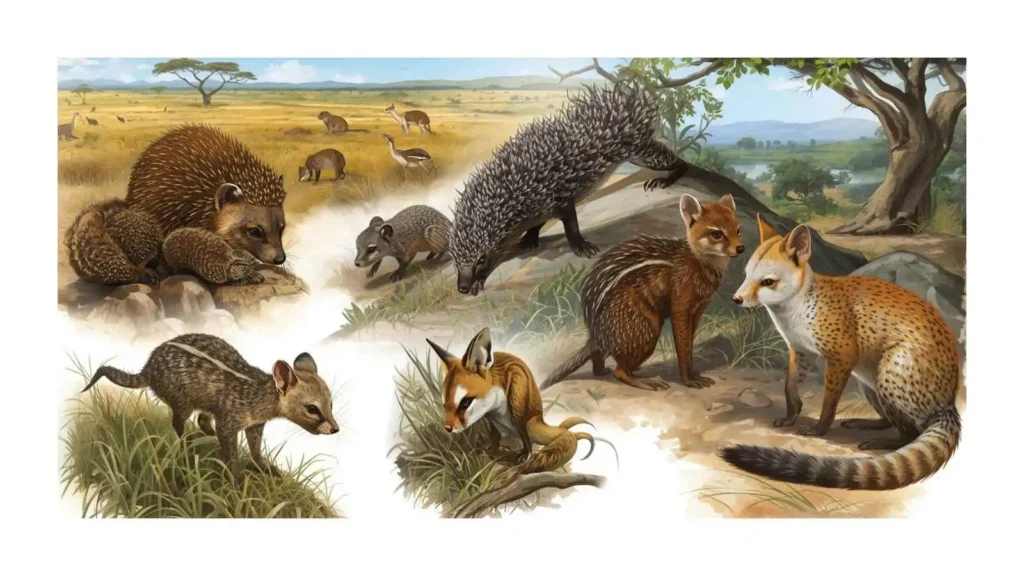
Though the continent’s little animals are just as fascinating, Africa is frequently praised for its magnificent megafauna. African small species, from tiny monkeys to tiny nocturnal mammals, are essential to ecosystems. Many fans look for “African small animals” in order to find unusual species that aren’t often mentioned in safari guides.
These organisms are vital to the equilibrium of the environment because they aid in pollination, seed distribution, and insect population control. In addition to providing useful information for wildlife observation, ecotourism, and conservation awareness, this page examines the diversity, behavior, and habitats of African tiny animals.
|See also: Endangered animals in south africa
African Small Animals – Quick Answer
African small animals are species that weigh under 20 kilograms on average, including rodents, small carnivores, primates, and insectivores. Examples include:
- Dwarf Mongoose – Africa’s smallest social carnivore.
- African Pygmy Hedgehog – Found in savannah and forest edges.
- Bush Baby (Galago) – Nocturnal primate with large eyes and strong leaping abilities.
- African Pygmy Squirrel – Tiny tree-dwelling rodents critical for seed dispersal.
- Fennec-like African Foxes – Small desert-adapted canids with large ears.
These species are crucial for maintaining ecological equilibrium and serve as indicators of habitat health.
Scientific Classification
| Animal | Kingdom | Phylum | Class | Order | Family | Genus/Species |
|---|---|---|---|---|---|---|
| Dwarf Mongoose | Animalia | Chordata | Mammalia | Carnivora | Herpestidae | Helogale parvula |
| African Pygmy Hedgehog | Animalia | Chordata | Mammalia | Erinaceomorpha | Erinaceidae | Atelerix albiventris |
| Bush Baby (Galago) | Animalia | Chordata | Mammalia | Primates | Galagidae | Galago spp. |
| African Pygmy Squirrel | Animalia | Chordata | Mammalia | Rodentia | Sciuridae | Myosciurus pumilio |
| Fennec-like African Fox | Animalia | Chordata | Mammalia | Carnivora | Canidae | Vulpes spp. |
Physical Characteristics
Small African animals are uniquely adapted to their environments:
- Dwarf Mongoose – Reddish-brown fur, slender body, sharp claws for digging.
- African Pygmy Hedgehog – Spiny coat for protection, nocturnal eyes.
- Bush Baby – Soft fur, large reflective eyes, elongated hind limbs for leaping.
- African Pygmy Squirrel – Tiny body, bushy tail, sharp incisors for gnawing.
- Fennec-like African Foxes – Large ears, sandy fur, small, agile body for desert survival.
These physical traits facilitate predator avoidance, thermoregulation, and foraging efficiency.
Habitat and Distribution
Small African animals inhabit a broad range of ecosystems:
- Dwarf Mongoose – Savannahs, woodlands, and scrublands across Southern and Eastern Africa.
- African Pygmy Hedgehog – Grasslands and forest edges in West and Southern Africa.
- Bush Baby – Tropical forests, dry woodlands, and riverine habitats in Sub-Saharan Africa.
- African Pygmy Squirrel – Rainforest canopies in West African regions.
- Fennec-like African Foxes – Semi-arid and desert landscapes of Northern Africa.
Proper habitat preservation is critical for sustaining populations and biodiversity.
Diet and Hunting Behavior
African small animals demonstrate diverse feeding strategies:
- Dwarf Mongoose – Insectivorous and omnivorous, hunting termites, beetles, and small vertebrates.
- African Pygmy Hedgehog – Feeds on insects, snails, and occasional fruits.
- Bush Baby – Nectar, insects, and tree sap, foraging at night using acute hearing.
- African Pygmy Squirrel – Herbivorous diet of seeds, nuts, and fruits.
- Fennec-like African Foxes – Opportunistic feeders, eating insects, rodents, and small birds.
Dietary flexibility helps these animals survive in changing environmental conditions.
Reproduction and Lifespan
Reproductive strategies vary across species:
- Dwarf Mongoose – Gestation ~60–70 days, 2–3 pups per litter, lifespan 6–8 years.
- African Pygmy Hedgehog – 30–40 days gestation, 2–5 offspring, lifespan ~5 years in the wild.
- Bush Baby – 120–130 days gestation, 1–2 infants, lifespan up to 13 years.
- African Pygmy Squirrel – 40–45 days gestation, 2–3 young, lifespan 4–6 years.
- Fennec-like African Foxes – 50–52 days gestation, 2–5 pups, lifespan 10–12 years.
Breeding success often depends on habitat stability and food availability.
Behavior and Adaptations
African small animals display remarkable survival adaptations:
- Dwarf Mongoose – Lives in tight-knit colonies with cooperative sentinel duties.
- African Pygmy Hedgehog – Rolls into a spiny ball to deter predators.
- Bush Baby – Utilizes leaping locomotion and ultrasonic calls for communication.
- African Pygmy Squirrel – Agile tree climber, often solitary.
- Fennec-like African Foxes – Large ears dissipate heat, enhance nocturnal hunting.
Social structure, camouflage, and nocturnal activity maximize survival in predator-rich environments.
Threats and Conservation Status
Small African animals face increasing risks:
- Habitat destruction – Deforestation, urbanization, and agriculture.
- Climate change – Alters food sources, water availability, and breeding patterns.
- Predation – Natural predators include birds of prey, snakes, and larger carnivores.
- Illegal wildlife trade – Hedgehogs and other small mammals are often trafficked.
Conservation measures include protected areas, community-led initiatives, and anti-poaching enforcement.
Interesting Facts
- Dwarf Mongoose communicates with complex vocalizations.
- Bush Babies can leap over 3 meters between trees.
- African Pygmy Hedgehogs use self-anointing behaviors to deter parasites.
- African Pygmy Squirrels play a key role in forest seed dispersal.
- Fennec-like African Foxes are the smallest canids in Africa.
FAQs
Q1: What are the smallest African mammals?
A: Species like dwarf mongooses, pygmy hedgehogs, and pygmy squirrels rank among Africa’s tiniest mammals.
Q2: Are small African animals dangerous?
A: Most are harmless to humans, but they play essential ecological roles and should be observed responsibly.
Q3: Where can I see African small animals in the wild?
A: National parks and reserves like Serengeti, Kruger, and Congo Rainforest are excellent habitats.
Q4: How can I help conserve them?
A: Support wildlife sanctuaries, eco-tourism, anti-poaching programs, and habitat restoration projects.
Q5: Do these animals make good pets?
A: Many species are unsuitable for captivity due to specialized diets and ecological needs.
Summary
Due to their small size, African creatures may be disregarded, although they are essential to maintaining ecological equilibrium. These animals, which range from bush infants to tiny mongooses, have remarkable adaptations, behaviors, and survival techniques.
Ecosystem stability and biodiversity are guaranteed by protecting their habitats. Understanding small African animals increases one’s awareness of the richness of the continent’s biodiversity and increases the effectiveness of conservation initiatives.