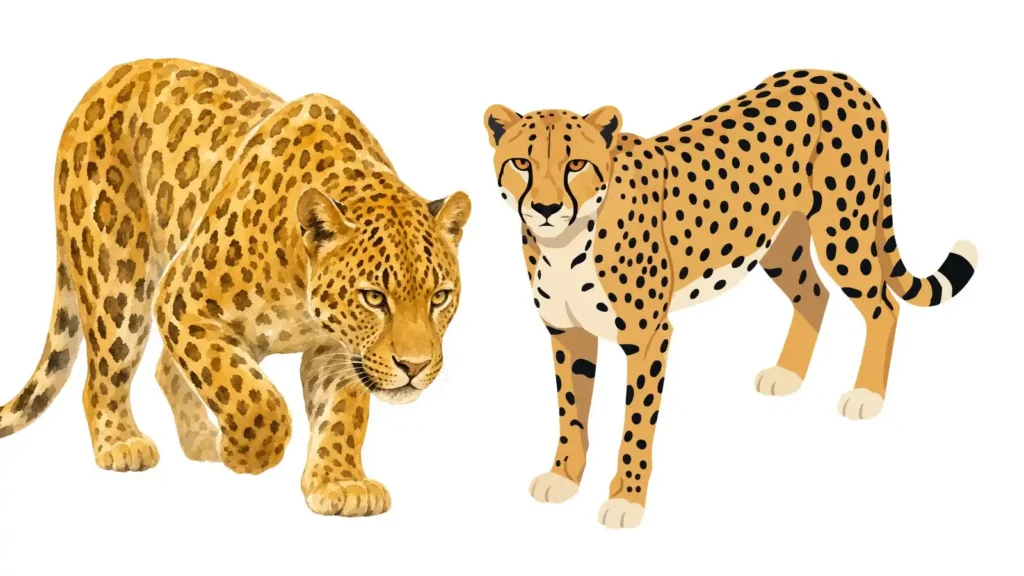
Leopards and cheetahs are two of Africa’s most recognizable big cats. At first glance, they look similar because both have spotted coats and athletic bodies. However, they are very different in appearance, behavior, hunting techniques, and habitat. Many people searching for “leopard or cheetah” want to know which animal is faster, stronger, or more dangerous.
This guide explains the major differences between these incredible predators using simple language and accurate wildlife facts. Whether you’re planning an African safari, studying wildlife, or simply curious about these magnificent cats, understanding their unique traits will help you identify them with confidence.
Leopard or Cheetah – Quick Answer
The biggest difference between a leopard or cheetah is their hunting style and body shape. A cheetah is the world’s fastest land animal, built for speed with a slim body and long legs. A leopard is stronger, stockier, and an excellent climber that relies on power, stealth, and surprise rather than speed.
Although both belong to the cat family, they evolved different survival strategies that make each species uniquely adapted to its environment.
See also: Wildlife on the Oregon Trail
Why Do People Confuse Leopards and Cheetahs?
Leopards and cheetahs share several physical features that make them easy to mistake for one another.
Both animals have:
- Golden-yellow fur
- Black spots
- Long tails
- Excellent eyesight
- Carnivorous diets
However, a closer look reveals important differences. The pattern of their spots, body build, facial markings, and behavior clearly distinguish one species from the other.
Leopard vs. Cheetah: Key Differences
Understanding a few simple characteristics makes identifying these cats much easier.
| Feature | Leopard | Cheetah |
|---|---|---|
| Body Build | Muscular and powerful | Slim and lightweight |
| Spots | Rosette-shaped markings | Solid black round spots |
| Face | No tear marks | Distinct black tear lines |
| Speed | Up to 36 mph (58 km/h) | Up to 70 mph (113 km/h) |
| Climbing | Excellent climber | Poor climber |
| Hunting Style | Ambush predator | High-speed chaser |
This comparison highlights why the two animals occupy different ecological roles.
Appearance Comparison
Although both cats are covered in spots, their coats tell different stories.
Leopard Appearance
Leopards have:
- Large, muscular bodies
- Broad heads
- Powerful shoulders
- Thick tails
- Rosette-shaped spots with lighter centers
Their stocky build allows them to drag heavy prey into trees, protecting it from scavengers like lions and hyenas.
Cheetah Appearance
Cheetahs have:
- Slender bodies
- Long legs
- Small rounded heads
- Deep chests
- Long tails for balance
- Solid black spots
- Black tear lines running from the eyes to the mouth
These tear marks help reduce sunlight glare, improving vision while chasing prey during the day.
Which Animal Is Faster?
When it comes to speed, there is no competition.
The cheetah is the fastest land animal on Earth.
It can accelerate from 0 to 60 mph (97 km/h) in just a few seconds and reach top speeds of approximately 70 mph (113 km/h) over short distances.
Leopards, while fast, rely less on sprinting.
They usually reach speeds of around 36 mph (58 km/h) but prefer stalking prey quietly before launching a short, explosive attack.
Why Cheetahs Are So Fast
Several unique adaptations make cheetahs exceptional runners.
These include:
- Lightweight skeleton
- Flexible spine
- Long legs
- Enlarged lungs
- Large nasal passages
- Long tail for steering
- Semi-retractable claws that provide extra grip
Together, these features allow cheetahs to chase prey with incredible speed and agility.
Hunting Style
The way these cats hunt is one of their greatest differences.
Leopard Hunting Strategy
Leopards depend on stealth.
They silently approach prey using tall grass, bushes, or darkness for cover before launching a powerful surprise attack.
Common prey includes:
- Antelope
- Monkeys
- Warthogs
- Small mammals
- Birds
After a successful hunt, leopards often carry their meal into trees to avoid losing it to larger predators.
Cheetah Hunting Strategy
Cheetahs hunt during daylight hours.
Instead of hiding for long periods, they slowly approach prey before beginning an incredibly fast chase.
Typical prey includes:
- Gazelles
- Impalas
- Young wildebeests
- Small antelope
- Hares
Because sprinting consumes enormous energy, cheetahs usually rest after a chase before eating.
Habitat and Distribution
Although both species are native to Africa, they prefer different environments.
Leopard Habitat
Leopards are among the most adaptable wild cats.
They live in:
- African savannas
- Rainforests
- Mountains
- Woodlands
- Semi-deserts
Leopards are also found in parts of Asia, making them one of the most widely distributed big cats.
Cheetah Habitat
Cheetahs prefer open landscapes where they can run at full speed.
They are commonly found in:
- Grasslands
- Open savannas
- Light woodlands
- Semi-arid regions
Today, most wild cheetahs live in eastern and southern Africa, with a small population surviving in Iran.
Leopard vs. Cheetah Comparison Table
| Characteristic | Leopard | Cheetah |
|---|---|---|
| Scientific Name | Panthera pardus | Acinonyx jubatus |
| Maximum Speed | 36 mph (58 km/h) | 70 mph (113 km/h) |
| Weight | 66–198 lbs (30–90 kg) | 46–160 lbs (21–72 kg) |
| Spot Pattern | Rosettes | Solid black spots |
| Climbing Ability | Excellent | Limited |
| Hunting Method | Ambush | High-speed chase |
| Active Time | Mostly night | Mostly day |
Can You Tell Them Apart Easily?
Yes. Once you know the key features, identifying a leopard or cheetah becomes much easier.
Look for these quick clues:
- Black tear marks = Cheetah
- Rosette-shaped spots = Leopard
- Slim body = Cheetah
- Muscular build = Leopard
- Running across open plains = Cheetah
- Resting in a tree = Leopard
These simple observations are often enough to distinguish the two species, even from a distance.
Diet and Feeding Habits
Although leopards and cheetahs are both carnivores, they hunt and eat differently.
Leopard Diet
Leopards are opportunistic predators and will eat almost any animal they can catch. Their powerful build allows them to hunt prey much larger than themselves.
Common leopard prey includes:
- Antelope
- Warthogs
- Monkeys
- Baboons
- Birds
- Porcupines
- Small reptiles
Leopards often drag their prey into trees to protect it from lions, hyenas, and other scavengers.
Cheetah Diet
Cheetahs focus on smaller, fast-moving animals that they can catch during high-speed chases.
Their favorite prey includes:
- Gazelles
- Impalas
- Springboks
- Young wildebeests
- Hares
Unlike leopards, cheetahs usually eat their prey on the ground because they lack the strength to carry large animals into trees.
Behavior and Social Structure
These two big cats have very different lifestyles.
Leopard Behavior
Leopards are solitary animals. Adults spend most of their lives alone except during mating or while females raise cubs. They are secretive, highly adaptable, and mostly active at night.
Their ability to hide quietly makes them one of Africa’s most successful predators.
Cheetah Behavior
Cheetahs are generally active during the day. Female cheetahs live alone with their cubs, while brothers often stay together in small groups called coalitions. This teamwork helps them defend territory and improve hunting success.
Lifespan and Conservation Status
Both species face threats from habitat loss, conflict with humans, and declining prey populations.
| Feature | Leopard | Cheetah |
|---|---|---|
| Average Lifespan (Wild) | 12–17 years | 10–12 years |
| Lifespan in Captivity | Up to 23 years | Up to 17 years |
| Main Threats | Habitat loss, poaching | Habitat loss, low genetic diversity |
| Conservation Status | Vulnerable | Vulnerable |
Conservation organizations continue working to protect these magnificent cats through habitat preservation, anti-poaching efforts, and community education.
Which Animal Is More Dangerous?
Both animals are wild predators and deserve respect. However, leopards are generally considered more dangerous to humans.
Why Leopards Are More Dangerous
Leopards are:
- Stronger and more muscular
- Excellent climbers
- Highly territorial
- Powerful enough to attack larger prey
- More likely to defend themselves aggressively when threatened
Why Cheetahs Are Less Dangerous
Cheetahs usually avoid people whenever possible. Their lightweight bodies are designed for speed rather than fighting, making them less aggressive than many other big cats.
Even so, visitors should never approach or attempt to feed either species in the wild.
Fascinating Facts About Leopards and Cheetahs
- The cheetah is the fastest land animal, reaching speeds of up to 70 mph (113 km/h).
- Leopards can carry prey weighing more than their own body weight into trees.
- A cheetah’s black tear marks help reduce sunlight glare during daytime hunts.
- Leopards are excellent swimmers, although they usually avoid water when possible.
- Cheetahs cannot roar like lions or leopards. Instead, they communicate with chirps, purrs, and meows.
- Leopards have one of the widest distributions of any wild cat, living in both Africa and parts of Asia.
- Every leopard and cheetah has a unique spot pattern, much like a human fingerprint.
Leopard or Cheetah: Which Is Better Adapted?
Neither animal is “better” overall. Each has evolved to thrive in a different way.
A cheetah excels in open grasslands, where speed is the key to survival. A leopard succeeds in forests, rocky hills, and woodlands, where stealth, strength, and climbing ability provide a major advantage.
Their unique adaptations allow both species to play essential roles in maintaining healthy ecosystems.
Frequently Asked Questions About Leopard or Cheetah
Is a leopard faster than a cheetah?
No. A cheetah is much faster and is the world’s fastest land animal, capable of reaching around 70 mph (113 km/h). Leopards are quick but rely more on stealth than speed.
How can you tell a leopard from a cheetah?
Look at the face and spots. Cheetahs have black tear marks running from their eyes to their mouths and solid black spots. Leopards have rosette-shaped spots and lack tear marks.
Which animal is stronger, a leopard or a cheetah?
Leopards are significantly stronger. Their muscular bodies allow them to climb trees while carrying heavy prey and defend themselves against larger predators.
Are leopards and cheetahs closely related?
Both belong to the cat family (Felidae), but they belong to different genera. Leopards are part of the Panthera genus, while cheetahs belong to the Acinonyx genus.
Can leopards and cheetahs live in the same habitat?
Yes. In many African national parks, both species share the same landscape. However, they reduce competition by hunting differently and using different habitats within the same ecosystem.
Which is more dangerous to humans?
Leopards are generally considered more dangerous because they are stronger, more territorial, and capable of defending themselves aggressively. Cheetahs usually avoid human contact.
Conclusion
When comparing leopard or cheetah, it becomes clear that these spotted cats are built for different lifestyles. The cheetah is the ultimate sprinter, relying on unmatched speed to chase prey across open plains. The leopard, on the other hand, depends on strength, stealth, and climbing skills to ambush prey and survive in a wide range of habitats.
Understanding these differences not only helps wildlife enthusiasts identify each species but also highlights the remarkable diversity of nature. Whether you encounter a leopard resting in a tree or a cheetah racing across the savanna, both animals represent some of the most extraordinary predators on Earth and deserve our respect and protection.